I think there is a bug in the calculation for the length after bending with the fold tool.
Steps to reproduce:
- Create a flat plate of 100 x 100 x 1 mm
- Create a sketch with a single line along the middle of the top surface of the plate
- Use this sketch to bend the plate with the fold command; leave the properties of the fold at the default values (r = 1, k = 0.5)
The expected bend allowance is
BA = pi / 2 * (r + k * T),
where r denotes the inner radius of the bend (r = 1), k is the k-factor (k = 0.5) and T is the material thickness (T = 1), so
BA = pi / 2 * (1 + 0.5 * 1) =~ 2.3562 mm.
Subtracting this from the original plate length (100 mm) and dividing by 2 gives an expected length of each leg of 48.8 mm. However, the model has legs with a length of 48.5 mm. (Larger values for thickness and radius give larger errors.)
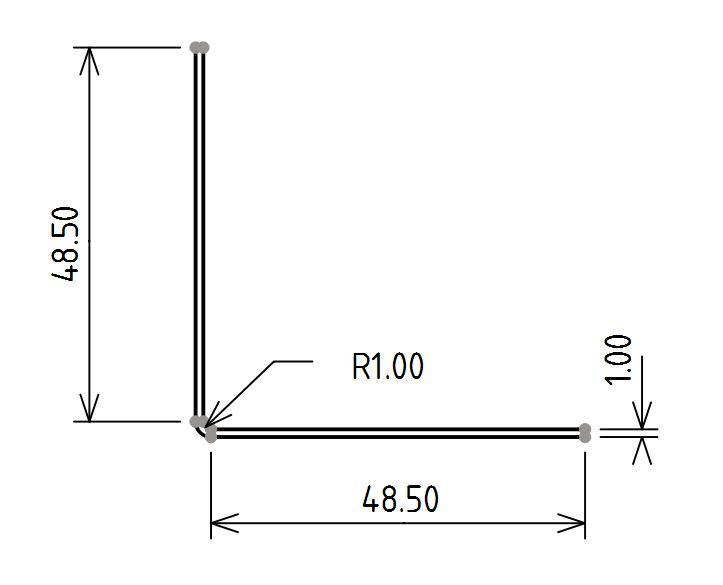
Another indication of a bug is the fact that when the folded model is flattened again with the unfold tool, the resulting plate is of a different length than the original plate.
I think there is a bug in the calculation for the length after bending with the fold tool.
Steps to reproduce:
The expected bend allowance is
BA = pi / 2 * (r + k * T),
where r denotes the inner radius of the bend (r = 1), k is the k-factor (k = 0.5) and T is the material thickness (T = 1), so
BA = pi / 2 * (1 + 0.5 * 1) =~ 2.3562 mm.
Subtracting this from the original plate length (100 mm) and dividing by 2 gives an expected length of each leg of 48.8 mm. However, the model has legs with a length of 48.5 mm. (Larger values for thickness and radius give larger errors.)
Another indication of a bug is the fact that when the folded model is flattened again with the unfold tool, the resulting plate is of a different length than the original plate.