
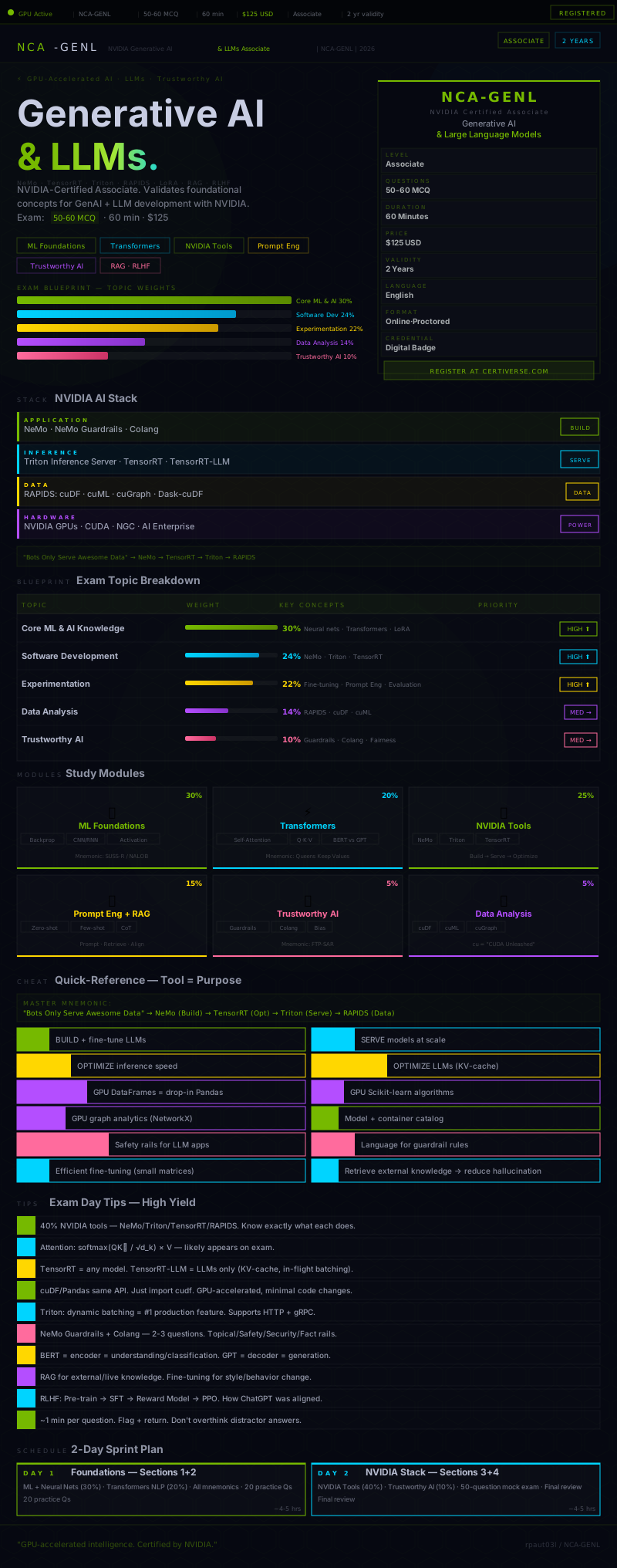
Exam: 50–60 questions | 60 minutes | Multiple choice Goal: Pass in 2 days with focused, high-yield study sprints.
| Day | Focus Areas | Weight |
|---|---|---|
| Day 1 | ML & Neural Network Foundations + Transformer / NLP Architecture | 50% of exam |
| Day 2 | NVIDIA Deployment Stack + Trustworthy AI | 50% of exam |
Study method: Read → Mnemonic → Active Recall (practice questions after each section).
| Type | Description | Example |
|---|---|---|
| Supervised | Labeled data → learns mapping | Spam detection |
| Unsupervised | No labels → finds patterns | Customer clustering |
| Semi-supervised | Small labeled + large unlabeled | Medical imaging |
| Self-supervised | Creates own labels from data | GPT pre-training (next-token prediction) |
| Reinforcement | Agent → action → reward signal | RLHF for LLMs |
Mnemonic — "SUSS-R" Supervised, Unsupervised, Semi-supervised, Self-supervised, Reinforcement "SUSS out the Right learning type"
| Component | Purpose |
|---|---|
| Neuron | Weighted sum + bias → activation function |
| Activation Functions | Introduce non-linearity (ReLU, Sigmoid, Tanh, Softmax) |
| Loss Function | Measures how wrong the model is (Cross-Entropy, MSE) |
| Optimizer | Updates weights to minimize loss (SGD, Adam) |
| Backpropagation | Chain rule to compute gradients layer-by-layer |
Mnemonic — "NALOB" Neuron → Activation → Loss → Optimizer → Backprop "NALOB: Neurons Activate, Loss Optimizes Backward"
| Function | Range | Use Case | Gotcha |
|---|---|---|---|
| ReLU | [0, ∞) | Hidden layers (default) | Dying ReLU (outputs 0 forever) |
| Sigmoid | (0, 1) | Binary classification output | Vanishing gradients |
| Tanh | (-1, 1) | Hidden layers (legacy) | Vanishing gradients |
| Softmax | (0, 1), sums to 1 | Multi-class output | Used in attention scores too |
Mnemonic — "Real Students Take Softmax" ReLU → Sigmoid → Tanh → Softmax
| Problem | Symptom | Solutions |
|---|---|---|
| Overfitting | High train accuracy, low test accuracy | Dropout, regularization (L1/L2), more data, early stopping |
| Underfitting | Low accuracy everywhere | Bigger model, more features, train longer |
Mnemonic — "DROP IT" (Overfitting cures) Dropout, Regularization, Out-of-sample validation, Prune less, Increase data, Terminate early
| Architecture | Best For | Key Feature |
|---|---|---|
| CNN | Images, spatial data | Convolutional filters, pooling |
| RNN | Sequential data | Hidden state carries memory |
| LSTM | Long sequences | Gates (forget, input, output) solve vanishing gradients |
| Transformer | NLP, modern LLMs | Self-attention, parallelizable |
Mnemonic — "CRLT" "CaRs Love Transformers" — CNN → RNN → LSTM → Transformer
| Concept | Definition |
|---|---|
| Epoch | One full pass through the training data |
| Batch Size | Number of samples per gradient update |
| Learning Rate | Step size for weight updates (too high = diverge, too low = slow) |
| Gradient Descent | Move in the direction that reduces loss |
| Vanishing Gradient | Gradients shrink to ~0 in deep networks → early layers don't learn |
Mnemonic — "Every Batch Learns by Gradient Victory" Epoch, Batch, Learning rate, Gradient descent, Vanishing gradient
The Transformer is the foundation of all modern LLMs (GPT, BERT, T5, LLaMA).
Core Idea: Replace recurrence with self-attention — process all tokens in parallel.
Input → [Embedding + Positional Encoding] → [Encoder Stack] → [Decoder Stack] → Output
| Component | What It Does |
|---|---|
| Input Embedding | Converts tokens → dense vectors |
| Positional Encoding | Injects word order info (sine/cosine or learned) |
| Multi-Head Attention | Multiple attention heads capture different relationships |
| Feed-Forward Network | Two linear layers + ReLU per position |
| Layer Normalization | Stabilizes training |
| Residual Connections | Skip connections to help gradient flow |
Mnemonic — "Every Position Matters, Feeding Layers Right" Embedding, Positional encoding, Multi-head attention, Feed-forward, Layer norm, Residual connections
Formula: Attention(Q, K, V) = softmax(QK^T / √d_k) × V
| Symbol | Meaning |
|---|---|
| Q (Query) | "What am I looking for?" |
| K (Key) | "What do I contain?" |
| V (Value) | "What information do I provide?" |
| √d_k | Scaling factor to prevent extreme softmax values |
Mnemonic — "Queens Keep Valuable Secrets" Query asks, Key matches, Value delivers, Scale stabilizes
Why multi-head? Each head learns a different type of relationship (syntax, semantics, co-reference). Outputs are concatenated and projected.
| Type | Architecture | Training Objective | Example | Best For |
|---|---|---|---|---|
| Encoder-only | Bidirectional attention | Masked Language Model (MLM) | BERT | Classification, NER, QA |
| Decoder-only | Causal (left-to-right) attention | Next-token prediction | GPT, LLaMA | Text generation |
| Encoder-Decoder | Full Transformer | Seq-to-seq | T5, BART | Translation, summarization |
Mnemonic — "BEG-T" BERT = Encoder, GPT = Decoder, T5 = Both "BEG T5 to do both"
| Method | How It Works |
|---|---|
| Word-level | Each word = 1 token (huge vocabulary) |
| BPE (Byte-Pair Encoding) | Merges frequent character pairs iteratively (GPT uses this) |
| WordPiece | Similar to BPE, used by BERT |
| SentencePiece | Language-agnostic, works on raw text |
Mnemonic — "Words Break into Word-Sentence Pieces" Word → BPE → WordPiece → SentencePiece
| Method | Description | When to Use |
|---|---|---|
| Full Fine-Tuning | Update all weights | Small model, lots of data |
| LoRA (Low-Rank Adaptation) | Train small rank-decomposition matrices | Large model, limited compute |
| P-Tuning / Prompt Tuning | Learn soft prompt embeddings | Very efficient, minimal changes |
| RLHF | RL with human preference reward model | Align model behavior (ChatGPT) |
| RAG | Retrieve external docs → augment prompt | Need current/private knowledge |
Mnemonic — "Fine-tune LLMs Properly, Really Accurately, Guaranteed" Full fine-tuning, LoRA, Prompt tuning, RLHF, Augmented retrieval (RAG), Guardrails
| Concept | Definition |
|---|---|
| Temperature | Controls randomness (0 = deterministic, 1+ = creative) |
| Top-k | Sample from top k most likely tokens |
| Top-p (nucleus) | Sample from smallest set whose cumulative probability ≥ p |
| Context Window | Max tokens the model can process at once |
| Hallucination | Model generates plausible but factually wrong content |
| Prompt Engineering | Designing inputs to get desired outputs (zero-shot, few-shot, CoT) |
Mnemonic — "Transformers Think Through Context, Handling Prompts" Temperature, Top-k/p, Context window, Hallucination, Prompt engineering
┌─────────────────────────────────────────────┐
│            APPLICATION LAYER                │
│    NeMo (Build & Fine-tune LLMs)            │
├─────────────────────────────────────────────┤
│            INFERENCE LAYER                  │
│    Triton Inference Server (Serve models)   │
│    TensorRT (Optimize for GPU inference)    │
├─────────────────────────────────────────────┤
│            DATA LAYER                       │
│    RAPIDS: cuDF, cuML, cuGraph              │
├─────────────────────────────────────────────┤
│            HARDWARE LAYER                   │
│    NVIDIA GPUs + CUDA                       │
└─────────────────────────────────────────────┘
Mnemonic — "Never Trust Raw Hardware" NeMo (build) → Triton + TensorRT (serve) → RAPIDS (data) → Hardware (GPU/CUDA)
Purpose: End-to-end framework for building, training, and fine-tuning LLMs and speech/vision models.
| Feature | Detail |
|---|---|
| NeMo Framework | Training & fine-tuning large models at scale |
| NeMo Guardrails | Add safety rails to LLM applications (topic control, fact-checking) |
| Supported models | GPT, LLaMA, Falcon, Mixtral, and more |
| Fine-tuning methods | Full, LoRA, P-Tuning, SFT, RLHF |
| Data parallelism | Distribute training across multiple GPUs |
| Model parallelism | Split a single model across GPUs (tensor & pipeline parallelism) |
Mnemonic — "NeMo: Nice Models, Guardrailed & Parallel" Build Nice Models with Guardrails using Parallelism
Purpose: Serve ML models at scale in production. Multi-framework, multi-model.
| Feature | Detail |
|---|---|
| Multi-framework | PyTorch, TensorFlow, TensorRT, ONNX, custom Python |
| Dynamic batching | Groups requests to maximize GPU utilization |
| Model ensemble | Chain multiple models in a pipeline |
| Concurrent model execution | Run different models simultaneously on same GPU |
| Model repository | Organized directory structure for model management |
| HTTP/gRPC endpoints | Standard APIs for inference requests |
| Metrics | Prometheus metrics for monitoring |
Mnemonic — "Triton Does Many Concurrent Ensembles" Triton: Dynamic batching, Multi-framework, Concurrent execution, Ensembles
Model Repository Structure:
model_repository/
├── model_name/
│   ├── config.pbtxt        # Model configuration
│   └── 1/                  # Version 1
│       └── model.plan      # TensorRT engine (or .pt, .onnx, etc.)
Purpose: Optimize deep learning models for maximum inference speed on NVIDIA GPUs.
| Optimization | What It Does |
|---|---|
| Layer Fusion | Combines multiple layers into one kernel |
| Precision Calibration | FP32 → FP16 / INT8 (faster, less memory) |
| Kernel Auto-Tuning | Selects best GPU kernel for each operation |
| Dynamic Tensor Memory | Reuses memory buffers efficiently |
| Multi-Stream Execution | Parallel execution of independent ops |
Mnemonic — "TensorRT: Layers Fuse Precisely, Kernels Dominate, Memory Streams" Or simply: "FLPKM" — Fusion, Lower precision, Profiling, Kernel tuning, Memory optimization
Workflow:
Trained Model (.onnx/.pt) → TensorRT Optimizer → Optimized Engine (.plan) → Deploy on Triton
Exam tip: TensorRT-LLM is specifically designed for LLM inference optimization. Know the difference:
- TensorRT = general deep learning inference optimizer
- TensorRT-LLM = specialized for LLMs with KV-cache, in-flight batching, tensor parallelism
| Library | GPU Replacement For | Purpose |
|---|---|---|
| cuDF | Pandas | GPU-accelerated DataFrames |
| cuML | Scikit-learn | GPU-accelerated ML algorithms |
| cuGraph | NetworkX | GPU-accelerated graph analytics |
| Dask-cuDF | Dask + Pandas | Multi-GPU, multi-node DataFrames |
Mnemonic — "RAPIDS CUres Slow Data" cuDF, cuML, cuGraph — everything starts with "cu" = CUDA Unleashed
Key exam point: RAPIDS provides a near-identical API to Pandas/Scikit-learn — minimal code changes to go from CPU → GPU.
# CPU (Pandas)
import pandas as pd
df = pd.read_csv("data.csv")

# GPU (cuDF) — same API!
import cudf
df = cudf.read_csv("data.csv")| Component | Purpose |
|---|---|
| NGC (NVIDIA GPU Cloud) | Catalog of pre-trained models, containers, Helm charts |
| NVIDIA AI Enterprise | Enterprise software suite for AI (support, security, management) |
| NVIDIA AI Foundations | Cloud services for custom generative AI model building |
| CUDA | Programming model for GPU parallel computing |
Mnemonic — "NGC: NVIDIA's Grand Catalog"
| Strategy | How It Works |
|---|---|
| Data Parallelism | Same model on each GPU, different data batches |
| Tensor Parallelism | Split individual layers across GPUs |
| Pipeline Parallelism | Split model layers into stages across GPUs |
| ZeRO (DeepSpeed) | Partition optimizer states, gradients, and parameters |
Mnemonic — "Data Travels in Pipeline Zones" Data parallelism, Tensor parallelism, Pipeline parallelism, ZeRO
| Principle | Description |
|---|---|
| Fairness | No bias against protected groups |
| Transparency | Explainable decisions |
| Privacy | Data protection, differential privacy, federated learning |
| Safety | Guardrails against harmful outputs |
| Accountability | Clear ownership of AI decisions |
| Robustness | Resistant to adversarial attacks |
Mnemonic — "FTP-SAR" Fairness, Transparency, Privacy, Safety, Accountability, Robustness "FTP your SAR (Safety Assurance Report)"
| Bias Type | Where It Occurs | Mitigation |
|---|---|---|
| Data Bias | Training data over/under-represents groups | Balanced datasets, data augmentation |
| Algorithmic Bias | Model learns biased patterns | Fairness constraints, bias audits |
| Evaluation Bias | Metrics don't capture fairness | Use disaggregated metrics per group |
What: A toolkit for adding programmable constraints to LLM applications.
| Feature | Purpose |
|---|---|
| Topical Guardrails | Keep conversations on-topic |
| Safety Guardrails | Block harmful/toxic content |
| Security Guardrails | Prevent prompt injection, jailbreaks |
| Fact-Checking Rails | Verify outputs against knowledge base |
| Colang | NVIDIA's modeling language for defining conversational guardrails |
Mnemonic — "Guard TSSF with Colang" Topical, Safety, Security, Fact-checking — written in Colang
| Tool | Remember As |
|---|---|
| NeMo | "Build and fine-tune" |
| Triton | "Serve models at scale" |
| TensorRT | "Optimize for fast inference" |
| RAPIDS/cuDF | "GPU DataFrames (drop-in for Pandas)" |
| cuML | "GPU Scikit-learn" |
| NGC | "Model/container catalog" |
| NeMo Guardrails | "Safety rails for LLM apps" |
| Colang | "Language for writing guardrails" |
| RLHF | "Align model with human preferences" |
| LoRA | "Efficient fine-tuning with small matrices" |
| RAG | "Retrieve external knowledge to reduce hallucination" |
"Build → Optimize → Serve → Accelerate Data" NeMo → TensorRT → Triton → RAPIDS "Bots Only Serve Awesome Data"
- Time management: ~1 minute per question. Don't overthink — flag and move on.
- NVIDIA tools make up 40% — know what each tool does and when to use it.
- Transformer attention formula will likely appear:
softmax(QK^T / √d_k) × V - cuDF vs. Pandas — remember: same API, GPU-accelerated, that's the selling point.
- Triton dynamic batching — the #1 feature for production inference scaling.
- NeMo Guardrails + Colang — expect 2-3 questions on this.
- TensorRT optimizations — layer fusion and precision reduction (FP16/INT8) are the key points.
- RLHF flow: Pre-train → SFT → Reward Model → PPO fine-tuning.
- Encoder vs. Decoder: BERT = understanding, GPT = generation. If the question is about classification → encoder. Generation → decoder.
- RAG vs. Fine-tuning: RAG for current/external knowledge, fine-tuning for behavior/style changes.
Which type of learning does GPT use during pre-training? A) Supervised Learning | B) Reinforcement Learning | C) Self-Supervised Learning | D) Unsupervised Learning
Answer: C — GPT uses next-token prediction, creating its own labels from raw text. That's self-supervised. Mnemonic: "SUSS-R" — GPT pre-trains on "Self"
In Attention(Q,K,V) = softmax(QK^T / √d_k) × V, what is the purpose of dividing by √d_k?
A) Normalize output values | B) Prevent large dot products pushing softmax into tiny-gradient regions | C) Reduce key dimensionality | D) Convert to probabilities
Answer: B — Large dot products → near-one-hot softmax → vanishing gradients. Scaling keeps values stable. Mnemonic: "Queens Keep Valuable Secrets" — without Scale, the Secret (gradient) vanishes
What is the primary purpose of NVIDIA Triton Inference Server? A) Fine-tuning LLMs with LoRA | B) Layer fusion and precision reduction | C) Serving ML models at scale with multi-framework support and dynamic batching | D) GPU-accelerated data preprocessing
Answer: C — Triton = production serving. NeMo = fine-tuning, TensorRT = optimization, RAPIDS = data. Mnemonic: "Triton Does Many Concurrent Ensembles"
A model gets 98% train accuracy but 62% test accuracy. What is this, and what helps? A) Underfitting — increase complexity | B) Overfitting — apply dropout and regularization | C) Vanishing gradients — use ReLU | D) Overfitting — increase learning rate
Answer: B — High train + low test = overfitting. Dropout & regularization help generalize. Mnemonic: "DROP IT" — Dropout, Regularization, Out-of-sample, Prune less, Increase data, Terminate early
Which model type for text classification (sentiment analysis)? A) Decoder-only (GPT) | B) Encoder-only (BERT) | C) Encoder-Decoder (T5) | D) RNN (LSTM)
Answer: B — BERT uses bidirectional attention = understands full context = ideal for classification. Mnemonic: "BEG T5 to do both" — BERT=Encoder(understands), GPT=Decoder(generates), T5=Both
Which RAPIDS library is a GPU-accelerated drop-in replacement for Pandas? A) cuML | B) cuGraph | C) cuDF | D) Dask
Answer: C — cuDF = CUDA DataFrames. Same API as Pandas, runs on GPU. Mnemonic: "RAPIDS CUres Slow Data" — cuDF = cuDA DataFrames
Adapt a 70B param LLM with limited GPU resources. Best method? A) Full fine-tuning | B) Train from scratch | C) LoRA | D) Increase context window
Answer: C — LoRA freezes original weights, trains small matrices. Low resources = LoRA. Mnemonic: "LoRA = Low Resources Allowed"
Which is NOT a TensorRT optimization? A) Layer fusion | B) Precision calibration | C) Dynamic batching | D) Kernel auto-tuning
Answer: C — Dynamic batching is Triton (serving), not TensorRT (model optimization). Mnemonic: "TensorRT optimizes the MODEL. Triton optimizes the SERVING."
What is NeMo Guardrails, and what language defines its rules? A) Training framework; Python | B) Safety constraints toolkit; Colang | C) Inference optimizer; YAML | D) Bias detection; JSON
Answer: B — NeMo Guardrails adds programmable safety rails. Rules written in Colang. Mnemonic: "Guard TSSF with Colang" — Topical, Safety, Security, Fact-checking
Multi-head attention: 8 heads, model dim 512. Dimension per head? A) 512 | B) 64 | C) 8 | D) 4096
Answer: B — 512 ÷ 8 = 64. Each head gets an equal slice, outputs concatenated back. Mnemonic: "Heads Divide, then Concatenate"
In NVIDIA's AI workflow, what is the correct order from training to production? A) Triton → TensorRT → NeMo | B) NeMo → TensorRT → Triton | C) TensorRT → NeMo → Triton | D) NeMo → Triton → TensorRT
Answer: B — Build (NeMo) → Optimize (TensorRT) → Serve (Triton). Always optimize before serving. Mnemonic: "Bots Only Serve Awesome Data" — Build → Optimize → Serve
BERT's MLM is self-supervised rather than supervised because? A) Requires human annotators | B) Model generates its own labels by masking and predicting tokens | C) Uses RL with reward signal | D) Clusters sentences without labels
Answer: B — The original tokens ARE the labels. GPT = next-token, BERT = masked-token. Both self-label. Mnemonic: "Self = Self-labeling"
Automated customer support chatbot that generates human-like responses. Which architecture? A) Encoder-only (BERT) | B) Decoder-only (GPT) | C) Encoder-Decoder (T5) | D) CNN
Answer: B — Chatbot generates new text = Decoder (GPT). BERT = understand, T5 = transform text→text. Mnemonic: "BERT Understands, GPT Generates, T5 Transforms"
Reduce inference latency by converting FP32 to FP16. Which tool? A) Triton | B) NeMo | C) TensorRT | D) RAPIDS cuML
Answer: C — Precision calibration is model optimization = TensorRT's job. Mnemonic: "FLPKM" — Fusion, Lower precision, Profiling, Kernel tuning, Memory optimization
Correct order of RLHF pipeline steps? A) Reward Model → Pre-training → SFT → PPO | B) Pre-training → SFT → Reward Model → PPO | C) SFT → Pre-training → PPO → Reward Model | D) Pre-training → PPO → Reward Model → SFT
Answer: B — Pre-train → SFT → Reward Model → PPO. How ChatGPT was built. Mnemonic: "Please Stop Reviewing Poorly" — Pre-train → SFT → Reward → PPO
Legal firm needs LLM to answer from private, frequently updated case law. Best approach? A) Full fine-tuning | B) LoRA | C) RAG | D) Increase temperature
Answer: C — Private + frequently updated = RAG. Fine-tuning bakes static knowledge into weights. Mnemonic: "RAG = Real-time Access to Grounded knowledge"
175B model can't fit on one GPU. Which strategy splits individual layers across GPUs? A) Data Parallelism | B) Tensor Parallelism | C) Pipeline Parallelism | D) Gradient Accumulation
Answer: B — Tensor = split WITHIN a layer. Pipeline = split BETWEEN layers. Data = split the data. Mnemonic: "Tensor = split the Tensor (inside layer)"
Which Triton feature groups multiple incoming requests to maximize GPU utilization? A) Model ensemble | B) Concurrent model execution | C) Dynamic batching | D) Model versioning
Answer: C — Dynamic batching groups requests on-the-fly. Triton's #1 production feature. Mnemonic: "Triton Does Many Concurrent Ensembles" — D = Dynamic batching
GPT models use which tokenization method? A) Word-level | B) Character-level | C) BPE | D) WordPiece
Answer: C — GPT = BPE (Byte-Pair Encoding). BERT = WordPiece. T5/LLaMA = SentencePiece. Mnemonic: "Good Pairs Together = Byte Pair Encoding"
Banking chatbot needs to prevent off-topic discussions. Which guardrail? A) Safety Guardrails | B) Security Guardrails | C) Topical Guardrails | D) Fact-Checking Rails
Answer: C — Staying on-topic = Topical Guardrails. Safety = block harm, Security = block attacks. Mnemonic: "Guard TSSF with Colang" — Topical, Safety, Security, Fact-checking
Most common activation function in the output layer of multi-class classification? A) ReLU | B) Sigmoid | C) Tanh | D) Softmax
Answer: D — Softmax outputs probabilities summing to 1. Sigmoid = binary, ReLU = hidden layers. Mnemonic: "Single class? Sigmoid. Multiple classes? SoftMax."
Where to download pre-trained models, GPU-optimized containers, and Helm charts? A) RAPIDS | B) NGC | C) NeMo | D) CUDA Toolkit
Answer: B — NGC = NVIDIA's Grand Catalog. One-stop shop for models, containers, charts. Mnemonic: "NGC: NVIDIA's Grand Catalog"
Extract disease names from medical records (NER). Which architecture? A) Decoder-only (GPT) | B) Encoder-only (BERT) | C) Encoder-Decoder (T5) | D) GAN
Answer: B — NER = labeling/classifying tokens = understanding = BERT (Encoder). Mnemonic: "BERT = Brain that Examines and Reads Text"
Most appropriate loss function for binary classification? A) MSE | B) Binary Cross-Entropy | C) Categorical Cross-Entropy | D) MAE
Answer: B — Cross-Entropy for Classification, MSE for Measurement (regression). Mnemonic: "Cross for Class, MSE for Measure"
What distinguishes TensorRT-LLM from standard TensorRT? A) TensorRT-LLM is for training | B) Adds KV-cache, in-flight batching, tensor parallelism for LLMs | C) Only supports PyTorch | D) Replaces Triton
Answer: B — TensorRT-LLM = TensorRT + KIT (KV-cache, In-flight batching, Tensor parallelism). Mnemonic: "TensorRT-LLM = TensorRT + KIT"
Which architecture was designed to solve vanishing gradients in sequential models? A) CNN | B) Standard RNN | C) LSTM | D) Autoencoder
Answer: C — LSTM uses three gates (Forget, Input, Output) to control gradient flow. Mnemonic: "LSTM = Long-term Saving Through Memory gates" — FIO fixes the flow
Developer provides 3 example input-output pairs before asking LLM to perform a task. What technique? A) Zero-shot | B) Few-shot | C) Chain-of-Thought | D) RAG
Answer: B — Providing examples = few-shot. CoT = step-by-step reasoning, not examples. Mnemonic: "Counting examples? Shot-counting. Showing reasoning? CoT."
Data scientist needs GPU-accelerated, API-compatible alternative to Scikit-learn's RandomForest? A) cuDF | B) cuGraph | C) cuML | D) Dask-cuDF
Answer: C — cuML = GPU Scikit-learn. cuDF = Pandas. cuGraph = NetworkX. Mnemonic: cuDF = DataFrames, cuML = Machine Learning, cuGraph = Graphs
Why do Transformers need positional encoding? A) Reduce dimensionality | B) Add word order since self-attention has no inherent position sense | C) Normalize attention weights | D) Prevent overfitting
Answer: B — Self-attention treats input as a set. Positional encoding injects order. Mnemonic: "No Position = No Order = No Meaning"
Correct Triton model repository structure?
A) models/model_name/model.pt | B) model_repository/model_name/config.pbtxt + .../1/model.plan | C) triton/models/config.yaml + .../weights.bin | D) repository/model_name/latest/model.onnx
Answer: B — config.pbtxt (not yaml) + numbered version dirs (not "latest"). Mnemonic: "pbtxt, not yaml. Numbers, not names."
Translate English to French. Which model? A) Encoder-only (BERT) | B) Decoder-only (GPT) | C) Encoder-Decoder (T5) | D) LSTM
Answer: C — Translation = REWRITE (one text into another) = Encoder-Decoder (T5). Mnemonic: "READ → BERT, WRITE → GPT, REWRITE → T5"
What happens if learning rate is set too high? A) Converges slowly but accurately | B) Overshoots optimal weights and may diverge | C) Underfits | D) Gradients vanish
Answer: B — Too high = big jumps = overshoot minimum = loss diverges. Mnemonic: "High = Hyper jumps, Low = Lazy crawls"
Which is NOT a NeMo capability? A) Training LLMs from scratch | B) Fine-tuning with LoRA/P-Tuning | C) Real-time serving with dynamic batching | D) Data and tensor parallelism
Answer: C — Serving = Triton. NeMo builds and trains, never serves. Mnemonic: "NeMo Never Serves"
Most effective approach to reduce hallucinations for company-specific data? A) Increase temperature | B) Larger model | C) RAG | D) More attention heads
Answer: C — RAG grounds responses in retrieved documents. Higher temp = more hallucination. Mnemonic: "RAG = Real Answers, Grounded"
During training, dropout sets 50% of neurons to zero. What happens at inference? A) Dropout continues | B) Dropout off, all neurons active, weights scaled | C) Only surviving neurons used | D) Dropout rate doubled
Answer: B — Dropout is training-only. At inference, full capacity with scaled weights. Mnemonic: "DROP at Train, FULL at Test"
Layers 1-20 on GPU1, 21-40 on GPU2, 41-60 on GPU3. What type of parallelism? A) Data | B) Tensor | C) Pipeline | D) ZeRO
Answer: C — Groups of layers split across GPUs = Pipeline. Single layer split = Tensor. Mnemonic: "Pipeline = split between layers (stages in a pipe)"
50,000 token document into a 32,000 token context window. What happens? A) Model auto-summarizes | B) Input truncated or request fails | C) Multi-pass automatically | D) Extra tokens stored in memory
Answer: B — Context window is a hard limit. No auto-summarization or memory. Mnemonic: "Context Window = Hard Wall"
Triton deployment needs preprocessing → inference → postprocessing in one request. Which feature? A) Dynamic batching | B) Model ensemble | C) Concurrent execution | D) Model versioning
Answer: B — Model ensemble chains models into a single pipeline. Mnemonic: "Ensemble = End-to-end pipeline"
5 hospitals want to train AI without sharing patient data. Which approach? A) Transfer learning | B) Data parallelism | C) Federated learning | D) Data augmentation
Answer: C — Federated learning trains locally, shares only model updates (gradients), never raw data. Mnemonic: "Data stays home, only gradients travel"
Match: 1) Summarize article, 2) Generate Python code, 3) Detect spam A) 1: Enc-Dec, 2: Decoder, 3: Encoder | B) 1: Decoder, 2: Encoder, 3: Enc-Dec | C) 1: Encoder, 2: Decoder, 3: Enc-Dec | D) 1: Enc-Dec, 2: Encoder, 3: Decoder
Answer: A — Summarize = REWRITE (T5), Generate code = WRITE (GPT), Detect spam = READ (BERT). Mnemonic: "READ → BERT, WRITE → GPT, REWRITE → T5"
| Domain | Correct | Total | Accuracy |
|---|---|---|---|
| ML Foundations | 7 | 10 | 70% |
| NLP/Transformers | 8 | 13 | 62% |
| NVIDIA Tools | 10 | 12 | 83% |
| Trustworthy AI | 3 | 3 | 100% |
| Fine-Tuning/RLHF | 3 | 3 | 100% |
| Overall | 28 | 40 | 70% |