A family of twelve open JSON specifications for the answer-engine and agent era — plus a fifteen-repo implementation stack that consumes them. Five core specs · three EdTech extensions · one HealthTech extension · one cross-cutting incident-disclosure spec · one buyer-side procurement Decision Card (v0.3 — adds
data_vault_targets+retention_envelope) · one InsurTech Claims Decision Card · one unified visualizer · one operator console · one unified MCP server · 107 live properties on kineticgain.com · all AGPL-3.0 (specs) + MIT (implementations).Public front door: suite.kineticgain.com.
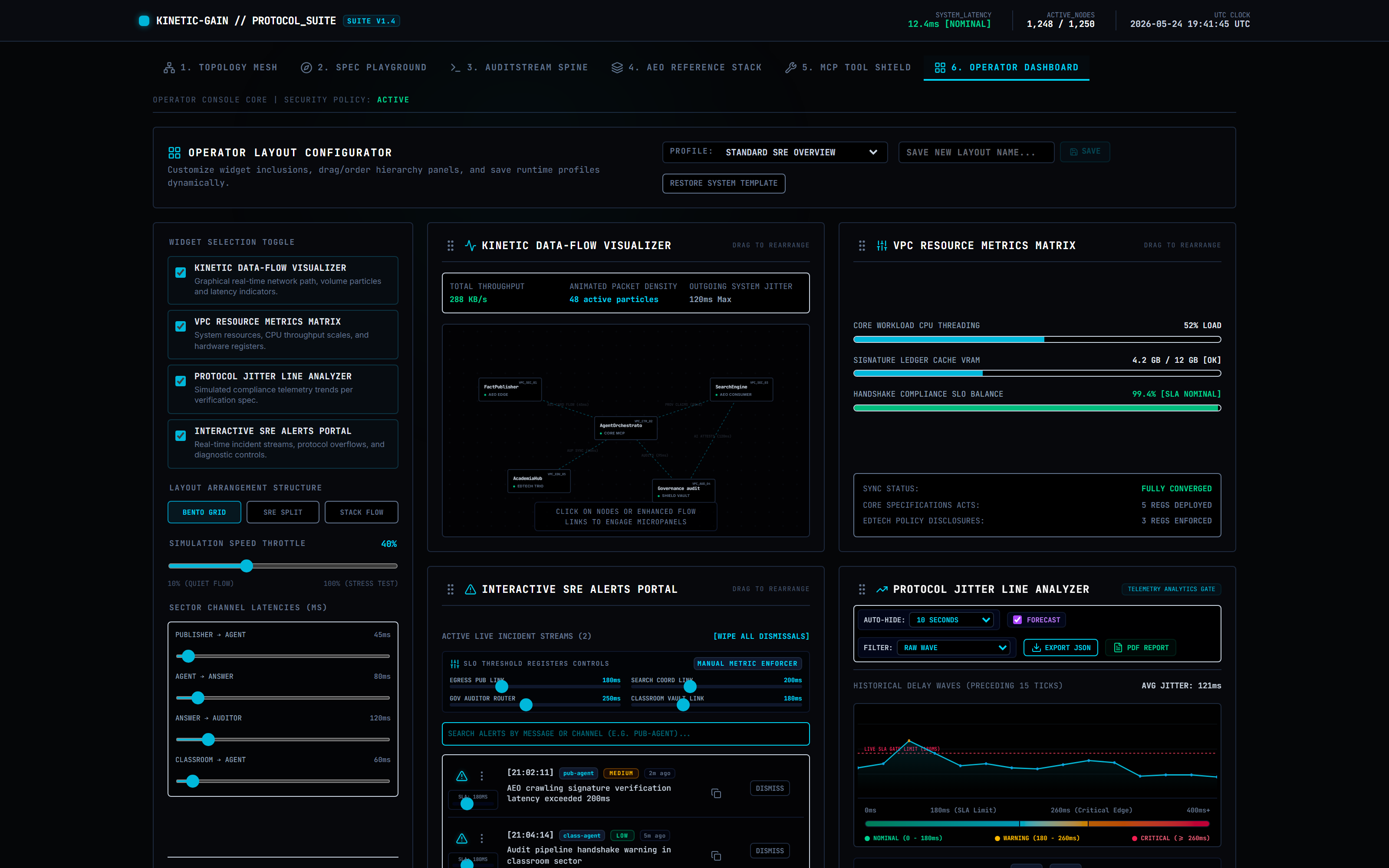
Kinetic Gain Operator Console — mission-control for the whole Suite: an interactive topology mesh (v0.2 — runtime-gate overlays for the MCP Permission Broker / Azure Governance Bridge / SQL Contract Enforcer, ed25519 signature posture, and blast-radius tracing across the hash-chained spine), a configurable SRE operator dashboard (savable layouts, simulation throttle, per-channel latency sliders, PDF export), and live audit-stream visualization. (repo)
 We publish the specs AND we score against them. Live receipt at kineticgain.com/.well-known/pulse-receipt.json, refreshed weekly by procurement-pulse-action on kineticgain.com's own GitHub Actions.
This repository is the single landing for the Suite — both for the specs (the "what to publish" layer) and for the implementation stack that consumes them (the "what to actually run" layer). Each spec lives in its own repo with full normative text, JSON Schema, examples, and a permissive cross-link table. This meta-repo is where you start when you want the map.
┌──────────────────── Core (Answer Engine / Agent layer) ────────────────────┐
│                                                                            │
│  AEO Protocol ──── entity declaration at /.well-known/aeo.json             │
│  Prompt Provenance ─ versioned, lineaged, reviewable LLM prompts          │
│  Agent Cards ───── capability + refusal disclosure for AI agents          │
│  AI Evidence Format ─ structured citations for LLM-generated claims       │
│  MCP Tool Cards ── per-tool disclosure for MCP servers                    │
│                                                                            │
└────────────────────────────────────────────────────────────────────────────┘
                                    │
                                    │ pairs with
                                    ▼
┌──────────────────── EdTech trio (vendor / district / student) ─────────────┐
│                                                                            │
│  AI Tutor Cards ── what an AI tutor does (vendor-side)                    │
│      ↕                                                                     │
│  Classroom AI AUP ─ what AI use is permitted (district / school / course) │
│      ↕                                                                     │
│  Student AI Disclosure ─ what the student actually did (per artifact)     │
│                                                                            │
└────────────────────────────────────────────────────────────────────────────┘

┌──────────────── HealthTech extension (vendor-side disclosure) ─────────────┐
│                                                                            │
│  Clinical AI Disclosure ── what a healthcare AI system does               │
│  HIPAA / FDA / SaMD posture · bias audits · EHR (FHIR / CDS Hooks)        │
│  references → Agent Card · AI Evidence · AI Incident Card                  │
│                                                                            │
└────────────────────────────────────────────────────────────────────────────┘
                                    │
                                    │ when things break
                                    ▼
┌──────────── Cross-cutting (vendor-published, references all) ──────────────┐
│                                                                            │
│  AI Incident Card ── post-incident disclosure ("CVE for AI agents")       │
│  references → Agent / Tutor / Tool Cards · Prompt Provenance · AI Evidence │
│                                                                            │
└────────────────────────────────────────────────────────────────────────────┘
                                    │
                                    │ buyer-side (when approving / rejecting)
                                    ▼
┌──────────── Cross-cutting (buyer-published, references vendor docs) ───────┐
│                                                                            │
│  AI Procurement Decision Card ── buyer's signed-off position on a vendor  │
│  status: approved / approved-with-conditions / rejected / withdrawn       │
│  references → AEO · Agent / Tool / Tutor / Clinical Cards · AI Evidence    │
│                                                                            │
└────────────────────────────────────────────────────────────────────────────┘
The Suite is bilateral: vendors publish disclosures (the first six rows); buyers publish Decision Cards that approve or reject those disclosures. AI Incident Cards close the loop when something breaks.
Every spec carries a top-level <name>_version field. The unified visualizer detects which spec a document is in by inspecting that single field.
| Spec | Repo | Detect via | Well-known path |
|---|---|---|---|
| AEO Protocol | aeo-protocol-spec |
aeo_version |
/.well-known/aeo.json |
| Prompt Provenance | prompt-provenance-spec |
provenance_version |
— |
| Agent Cards | agent-cards-spec |
agent_card_version |
/.well-known/agents/<agent_id>.json |
| AI Evidence Format | ai-evidence-format-spec |
evidence_version |
— |
| MCP Tool Cards | mcp-tool-card-spec |
tool_card_version |
/.well-known/mcp-tools/<tool_name>.json |
| AI Tutor Cards (EdTech) | ai-tutor-card-spec |
tutor_card_version |
/.well-known/tutors/<tutor_id>.json |
| Student AI Disclosure (EdTech) | student-ai-disclosure-spec |
disclosure_version |
— (travels with the artifact) |
| Classroom AI AUP (EdTech) | classroom-ai-aup-spec |
aup_version |
/.well-known/ai-aup.json |
| Clinical AI Disclosure (HealthTech) | clinical-ai-disclosure-spec |
clinical_ai_card_version |
/.well-known/clinical-ai/<system_id>.json |
| AI Incident Card (cross-cutting, vendor-side) | ai-incident-card-spec |
incident_card_version |
/.well-known/ai-incidents/<id>.json (+ index at /.well-known/ai-incidents.json) |
| AI Procurement Decision Card (cross-cutting, buyer-side) | ai-procurement-decision-spec |
decision_card_version |
/.well-known/procurement-decisions/<id>.json |
| AI Claims Decision Card (InsurTech, buyer-side) | ai-claims-decision-card-spec |
claims_card_version |
(travels with the artifact) |
All twelve: AGPL-3.0 spec text, freely implementable, v0.1 draft, JSON Schema draft 2020-12, tagged kinetic-gain-protocol-suite. The NIST AI RMF crosswalk maps every spec — plus the implementation tooling below — to specific NIST AI RMF subcategories.
The Suite now has real implementation tooling attached to several of its disclosure and distribution patterns:
- MCP Tool Cards
mcp-tool-card-generator— emits Tool Card disclosures directly from MCPtools/listoutputmcp-registry-risk-scanner— validates manifest and registry posture around published MCP serversmcp-tools-diff— detectstools/listdrift and breaking-change posture over time
- Agent Cards
agent-card-runtime-adapters— maps Agent Cards into runtime adapters for OpenAI, Anthropic, and Vercel execution layers
- AI Evidence Format / Evidence Ledger
rag-evidence-graph— corpus-level citation graph and evidence coverage analysisrag-evidence-trace-linker— per-call trace linkage for evidence integrity on RAG and generation flows
/.well-known/distribution patternwellknown-index-aggregator— builds and validates/.well-known/index.jsonfor multi-doc publisher estatesgovernance-disclosure-operator— Kubernetes-native publisher for governance disclosures
The Suite is a set of specs. This section is the software that consumes them — fifteen repos across Tiers A–E, all CI-green, semver-tagged, MIT-licensed, with five cross-ecosystem hooks tying them together. Grouped by the buyer most likely to land on the repo first.
flowchart TB
    classDef spec fill:#10b981,stroke:#065f46,color:#fff,stroke-width:2px
    classDef hook fill:#3b82f6,stroke:#1e40af,color:#fff,stroke-width:2px
    classDef sup fill:#f3f4f6,stroke:#6b7280,color:#1f2937
    classDef stream fill:#f59e0b,stroke:#92400e,color:#fff
    classDef mcp fill:#a855f7,stroke:#581c87,color:#fff,stroke-width:2px

    SPECS["📐 11 Suite specs<br/>AEO · Agent · Tool · Tutor · AUP · Disclosure<br/>Evidence · Provenance · Clinical · Incident · Decision"]:::spec

    SPECS -->|"#1 ingest Suite docs"| PDA["procurement-decision-api<br/>drafts Decision Cards"]:::hook
    PDA -->|"#2 conditions → runtime gates"| PAC["policy-as-code-engine<br/>PolicyBundle enforcement"]:::hook
    PDA -->|"#3 extract owners"| DCR["data-contract-registry<br/>schema + SLAs"]:::hook
    DCR -->|"#4 streaming CSV check"| CDQ["csv-data-quality-rs<br/>row-by-row validation"]:::hook
    DCR -->|"#5 contract → DDL"| SCE["sql-contract-enforcer<br/>cross-dialect table constraints"]:::hook

    SPECS -.->|sign + verify| HA["hash-attestation-rs<br/>ed25519 over canonical hash"]:::sup
    SPECS -.->|drift detection| AVS["aeo-validator-service<br/>always-on validation"]:::sup
    AVS -.->|JSONL feed| AGE["aeo-graph-explorer-rs<br/>graph-query layer #5"]:::sup
    SPECS -.->|incident → plan| ICR["incident-correlation-rs<br/>Suite-graph BFS"]:::sup
    ICR -.->|drives| PAC

    PDA --> AS
    PAC --> AS
    DCR --> AS
    AVS --> AS
    ICR --> AS
    HA --> AS
    AS["📋 audit-stream-py<br/>hash-chained tamper-evident spine"]:::stream

    SPECS ==>|spec tools| MCP
    PDA ==>|preview tools| MCP
    AS ==>|event tools| MCP
    HA ==>|verify tools| MCP
    MCP["🤖 mcp-kinetic-gain v0.9.1<br/>75 tools · one Claude Desktop config entry"]:::mcp
Green = the spec foundation. Blue = the five cross-ecosystem hooks that make this a stack rather than a pile of repos. Grey = supporting tools that feed either side. Amber = the tamper-evident audit-stream spine every governance moment writes to. Purple = the unified MCP surface that exposes the whole thing to Claude.
Zoom in on the amber spine: every governance moment in the stack writes to one hash-chained, tamper-evident log via audit-stream-py. Same opt-in env-var contract (AUDIT_STREAM_URL) across every producer; same best-effort semantics (a failed POST is logged, never raised). The original seven (four FastAPI services + three Rust crates) are now joined by four runtime + data-tier producers — mcp-permission-broker and azure-openai-governance-bridge (tool-invocation gates), pg-audit-stream-extension (Postgres CRUD via pg_notify), and wp-kinetic-gain-audit (WordPress/MySQL) — so the spine now spans Python, Rust, PL/pgSQL, PHP, and Azure Functions. One verifiable narrative an auditor can replay end-to-end, no matter which tier emitted the event.
flowchart LR
classDef pyprod fill:#3b82f6,stroke:#1e40af,color:#fff,stroke-width:2px
classDef rsprod fill:#dea584,stroke:#92400e,color:#1f2937,stroke-width:2px
classDef spine fill:#f59e0b,stroke:#92400e,color:#fff,stroke-width:3px
classDef sink fill:#f3f4f6,stroke:#6b7280,color:#1f2937
PDA["procurement-decision-api<br/>Python · FastAPI"]:::pyprod
AVS["aeo-validator-service<br/>Python · FastAPI"]:::pyprod
PCE["policy-as-code-engine<br/>Python · FastAPI"]:::pyprod
DCR["data-contract-registry<br/>Python · FastAPI"]:::pyprod
HA["hash-attestation<br/>Rust · crypto library"]:::rsprod
ICR["incident-correlation<br/>Rust · graph library"]:::rsprod
AGE["aeo-graph-explorer<br/>Rust · axum service"]:::rsprod
MPB["mcp-permission-broker +<br/>azure-openai-governance-bridge<br/>Python · runtime gates"]:::pyprod
PGX["pg-audit-stream-extension<br/>PL/pgSQL · pg_notify"]:::rsprod
WPA["wp-kinetic-gain-audit<br/>PHP · WordPress/MySQL"]:::rsprod
PDA -->|"decision_card_drafted"| AS
AVS -->|"watch_created<br/>watch_drifted<br/>watch_validity_flipped"| AS
PCE -->|"policy_bundle_registered<br/>request_allowed<br/>request_denied"| AS
DCR -->|"contract_promoted<br/>contract_deprecated<br/>contract_compatibility_failed"| AS
HA -->|"attestation_signed<br/>attestation_verified<br/>attestation_failed"| AS
ICR -->|"incident_correlated<br/>incident_correlation_failed"| AS
AGE -->|"graph_ingested<br/>graph_ingest_failed"| AS
MPB -->|"tool_invocation_allowed<br/>tool_invocation_denied<br/>tool_invocation_required_approval"| AS
PGX -->|"<configured kind> on table CRUD"| AS
WPA -->|"content_published<br/>plugin_activated<br/>user_role_changed"| AS
AS{{"📋 audit-stream-py<br/>hash-chained · tamper-evident<br/>SSE live tail · REST query · GET /verify"}}:::spine
AS -->|GET /events/stream| LT["governance dashboards<br/>(live tail)"]:::sink
AS -->|GET /events| Q["compliance evidence<br/>(REST query)"]:::sink
AS -->|GET /verify| V["auditor replay<br/>(walk the chain)"]:::sink
Blue = Python FastAPI producers. Tan = Rust producers (two libraries gated behind --features audit-stream so library consumers can strip out the HTTP dep, one axum service with the feature on by default). Amber = the spine itself. Grey = the three downstream surfaces auditors and operators consume.
Adding the next producer is a ~60-line module: copy the audit_stream shape (Python, Rust, PL/pgSQL, or PHP), pick your event kinds, point at AUDIT_STREAM_URL. The data-tier producers prove the point — pg-audit-stream-extension catches direct DML the application path would miss, and wp-kinetic-gain-audit brings the same tamper-evident chain to any WordPress estate. Next natural candidates: slo-budget-tracker (slo_burn_started / slo_recovered) or reliability-toolkit-rs (breaker_opened / breaker_recovered).
| Repo | Lang | What it does |
|---|---|---|
procurement-decision-api |
Python · FastAPI | Drafts AI Procurement Decision Cards from a buyer rubric and a set of vendor Suite documents (AEO + agent-card + tool-card + ai-evidence + …). The first cross-ecosystem bridge in the portfolio — Suite × Decision Intelligence. |
policy-as-code-engine |
Python · FastAPI | Declarative policy evaluator. Headline: POST /bundles/from-decision-card turns a Decision Card's conditions[] into a runtime-enforceable PolicyBundle. Closes the loop from "buyer signed off" to "request gated." Cross-ecosystem hook #2. |
hash-attestation-rs |
Rust · ed25519 | Sign and verify Suite documents with ed25519 over the canonical-hash convention every other Suite repo already uses. The missing "this AEO actually came from the vendor" layer. |
| Repo | Lang | What it does |
|---|---|---|
aeo-validator-service |
Python · FastAPI | Always-on HTTP validator for AEO + all 11 Suite docs. Auto-detects the spec via *_version sniffing, hashes canonically, tracks drift across re-checks (POST /watches/{id}/recheck returns a structured DriftReport). Layer 4 of the AEO Reference Stack. |
aeo-graph-explorer-rs |
Rust · axum · petgraph | HTTP graph-query service over aeo-crawler JSONL output. GET /neighbors, GET /shortest-path, GET /find-by-claim, atomic POST /ingest. Layer 5 of the AEO Reference Stack. |
incident-correlation-rs |
Rust · petgraph | Walks the Suite graph from an IncidentCard and emits a structured remediation plan: DecisionCard → RecheckPolicy, Vendor → RequestReview, AEO/agent/tool → Revalidate. |
| Repo | Lang | What it does |
|---|---|---|
data-contract-registry |
Python · FastAPI | Schema registry with semver versioning, compatibility checks (backward / forward / full), declared owners, freshness SLAs. POST /contracts/owners/from-decision-card pulls Owner records out of a Procurement Decision Card. Cross-ecosystem hook #3. |
csv-data-quality-rs |
Rust · tokio · csv | Streaming CSV validator against a data-contract-registry contract. Async, row-by-row, structured violation report (required / bad_type / enum_mismatch / column_count_mismatch / invalid_json). Cross-ecosystem hook #4. |
sql-contract-enforcer |
Python · SQL | Turns a data-contract-registry contract into enforceable cross-dialect DDL (CHECK / NOT NULL / UNIQUE / PK / FK) for Postgres, MySQL, Snowflake, BigQuery, plus a contract-vs-schema checker for CI. Dialect-aware (BigQuery demotes CHECK/UNIQUE to comments + PK/FK to NOT ENFORCED). Cross-ecosystem hook #5. |
Ten repos that compose into a single layered reliability story: identity → rate limits → canary → registry → SLO budget → Rust primitives → feature flags → shadow traffic → tamper-evident audit log.
| Repo | Lang | What it does |
|---|---|---|
slo-budget-tracker |
Python · FastAPI · Prometheus | SLO + error-budget library, multi-window burn-rate alerts (SRE workbook threshold 14.4). |
reliability-toolkit-rs |
Rust · Tokio | Token-bucket rate limiter · 3-state circuit breaker · exponential-backoff retry with jitter · bulkhead. |
feature-flag-rs |
Rust · Tokio | Server-side flag eval — targeting rules, sticky percentage rollouts (SHA-256 bucketing, no RNG), hot reload. |
request-shadow-rs |
Rust · Tokio | Async request mirroring with sampling + divergence detection. The SRE primitive for safe migrations. |
audit-stream-py |
Python · FastAPI · SSE | Append-only governance event stream, hash-chained for tamper-evidence. Every portfolio repo can produce events here. |
| (Plus 5 earlier reliability repos) | Python | rate-limit-shield · identity-mesh · agent-canary · model-registry-pro — defense-in-depth predecessors. |
| Repo | Lang | What it does |
|---|---|---|
mcp-kinetic-gain |
TypeScript | Unified Suite MCP server — 75 tools across 12 specs + DefenseTech 6-pack (v0.9.1, on the official MCP Registry). One Claude Desktop config entry. Headline tools: aup_check_compliance (joins AUP + Disclosure into one allow/deny call); decision_card_validate (enforces the full Decision Card conditional rule set); defensetech_vault_resolve_3axis (resolves CUI × export-control × foreign-person to the most-restrictive vault policy). |
mcp-reliability-toolkit |
TypeScript | Reliability MCP server — compute_slo_burn, design_rate_limiter, design_circuit_breaker, compose_reliability_pattern. Same math as slo-budget-tracker; emits Python + Rust configs. |
mcp-decision-intelligence |
TypeScript | Decision Intelligence MCP server — validate_decision_card, preview_policy_bundle, plan_incident_remediation, check_contract_compatibility. Read-only preview of what the live Python/Rust services would compute. |
The Decision Card layer decides; these gates enforce, at the moment a tool is invoked, and write every verdict to the spine:
| Repo | Lang | What it does |
|---|---|---|
mcp-permission-broker |
Python | Runtime gate between a Decision Card and an MCP tool call. Composes Decision Card conditions into deny-trumps-allow PolicyBundles; emits tool_invocation_* to the spine. |
azure-openai-governance-bridge |
Python · Azure Functions · Bicep | The Azure-native sibling — an Azure Function in front of Azure OpenAI enforcing the same PolicyBundle contract on every chat-completion call (deployment + each declared tool). Puts the Suite's governance on the data path enterprises actually run AI on. |
What makes the stack a stack rather than a list of repos:
procurement-decision-api→ Suite documents. Ingests AEO / agent-card / tool-card / ai-evidence by URL; emits a Decision Card. (Suite × Decision Intelligence.)policy-as-code-engine→procurement-decision-api.POST /bundles/from-decision-cardturns approve / reject / approve-with-conditions into runtime-enforceable allow / deny / per-condition gates.data-contract-registry→procurement-decision-api.POST /contracts/owners/from-decision-cardextracts buyer + decision_maker into Owner records so freshly registered contracts carry paging info nobody re-types.csv-data-quality-rs→data-contract-registry. Streaming CSV validator against a registered contract — producers prove their output matches, row by row.sql-contract-enforcer→data-contract-registry. Compiles the same contract into cross-dialect DDL (CHECK / NOT NULL / UNIQUE / PK / FK across Postgres, MySQL, Snowflake, BigQuery) — enforcing at the table boundary what hook #4 validates row-wise.
The implementation stack is independently usable — any repo composes with the rest, none requires it — and the Decision Card now enforces at three layers: the MCP tool call (mcp-permission-broker), the Azure OpenAI call (azure-openai-governance-bridge), and the database table (sql-contract-enforcer).
mcp-kinetic-gain (v0.9.1, on the official MCP Registry) is the unified Model Context Protocol server exposing every runtime Kinetic Gain spec as callable tools. One Claude Desktop / Cursor / MCP-client config entry; 75 tools across all twelve specs plus the DefenseTech 6-pack (3-axis vault resolver + CUI/ITAR/DFARS invariants + CMMC evidence summarizer + Incident Card event classifier).
| Spec | Tools |
|---|---|
| AEO Protocol | aeo_fetch · aeo_inspect · aeo_get_claim · aeo_well_known_url |
| Prompt Provenance | prompt_provenance_validate · prompt_provenance_inspect · prompt_provenance_eval_result |
| Agent Cards | agent_card_well_known_url · agent_card_inspect · agent_card_tool_disclosure · agent_card_validate |
| AI Evidence Format | ai_evidence_validate · ai_evidence_inspect · ai_evidence_verify_hash |
| MCP Tool Cards | tool_card_well_known_url · tool_card_inspect · tool_card_tested_with · tool_card_validate |
| AI Tutor Cards | tutor_card_well_known_url · tutor_card_fetch · tutor_card_validate · tutor_card_inspect · tutor_card_subject_check · tutor_card_coppa_check |
| Student AI Disclosure | disclosure_validate · disclosure_inspect · disclosure_verify_artifact_hash · disclosure_verify_prompt_hash · disclosure_aup_check |
| Classroom AI AUP | aup_well_known_url · aup_fetch · aup_validate · aup_inspect · aup_check_compliance |
| Clinical AI Disclosure | clinical_ai_well_known_url · clinical_ai_validate · clinical_ai_inspect · clinical_ai_samd_check |
| AI Incident Card | incident_validate · incident_inspect · incident_index_fetch · incident_affected_walk |
| AI Procurement Decision Card | decision_card_validate · decision_card_inspect · decision_card_conditions · decision_card_signature_check |
172 tests pass · typecheck clean · stdio MCP server, drops into any MCP-compatible client. Sibling MCP servers for the Reliability Stack (mcp-reliability-toolkit) and Decision Intelligence (mcp-decision-intelligence) exist for narrower use cases.
kinetic-gain-visualizer auto-detects the spec from the top-level *_version field and renders the appropriate procurement-grade view. Live on GitHub Pages.
- Visualize — the auto-detected renderer (FERPA / COPPA / GDPR badges for tutor cards, role-tone pills + artifact-hash binding for disclosures, vendor-requirements card in dark/authority tone for AUPs, full conditional-rule preview for Decision Cards, etc.)
- Editor — paste any spec document and watch the right view light up
- Architecture — the 12-spec map
- Tools — searchable catalog of all 63 MCP tools
- About — detection model + cross-links
A pre-built set of GitHub Actions for PR-gating governance documents before merge. Drop them into any repo that holds AgentCards / Tool Cards / prompt-provenance / evidence bundles / OTel spans and they post a Markdown summary as a PR comment + fail the build on high-severity findings.
| Action | Wraps | Catches |
|---|---|---|
agent-card-fleet-summary-action |
agent-card-fleet-summary |
autonomous-without-IRU, destructive-on-non-autonomous, persistent-memory-without-refusal-taxonomy |
mcp-tool-card-fleet-summary-action |
mcp-tool-card-fleet-summary |
destructive-without-human-approval, high-PII-without-rate-limit, writes-secrets-without-audit |
prompt-provenance-fleet-summary-action |
prompt-provenance-fleet-summary |
approved-without-evaluations, no-reviewers, failing-eval-on-approved, deprecated-still-referenced |
evidence-bundle-fleet-summary-action |
evidence-bundle-fleet-summary |
bundle-expired, unsigned-regulated-bundle, cross-bundle-hash-collision, oversized-bundle |
| Action | Catches |
|---|---|
kg-suite-spec-version-tracker-action |
Version drift — same protocol on two different spec versions in one fleet |
kg-suite-conformance-runner-action |
Structural conformance — missing required top-level blocks per spec |
kg-suite-canonicalize-action |
Silent edits — doc's canonical sha256 changed without a version bump |
| Action | Catches |
|---|---|
llm-cost-rollup-action |
GenAI FinOps — budget breaches across OTel cost-annotated spans |
k8s-pre-merge-action |
K8s pre-merge — deprecated APIs, RBAC over-scope, Pod Security, Helm values coverage |
All nine are composite Node 20 actions with dist/ committed for SHA/tag pinning — no build step needed in the consuming workflow.
| Repo | What it does |
|---|---|
prompt-injection-bench |
Open 30-attack prompt-injection corpus + Python harness. Every record carries an agent_card_refusal_categories back-ref to the Agent Card refusal_taxonomy[].category it tests. A vendor can grep their declared categories against the corpus to verify their stated commitments hold under attack — and failed runs become natural inputs for AI Incident Cards. Visual harness live at bench.kineticgain.com. |
The bench is not a twelfth spec — it's the testing-counterpart to the disclosure layer. The Suite tells you what an agent should refuse; the bench tells you whether it actually does.
| URL | What it serves |
|---|---|
| suite.kineticgain.com | Canonical front door for the entire Suite — 12-spec map, full spec table, two-front-doors section, NIST RMF crosswalk |
| docs.kineticgain.com | Quickstart hub — per-role guides + canonical /.well-known/ path map |
| directory.kineticgain.com | Vendor directory — curated list of domains publishing Kinetic Gain documents |
| examples.kineticgain.com | Examples gallery — sidebar of 11 specs, click for canonical example with JSON highlight |
| walker.kineticgain.com | well-known-walker — paste any domain, see every Kinetic Gain disclosure it publishes |
| bench.kineticgain.com | prompt-injection-bench — paste a JSONL transcript, see pass rates by category and severity |
| pulse.kineticgain.com | AI Procurement Pulse — quarterly research index of vendor disclosure across the open internet. Issue #1 "The Zero Baseline" is live (powered by procurement-pulse-engine + well-known-probe-js) |
| console.kineticgain.com | Operator Console — mission-control for the Suite: interactive topology mesh (v0.2 — runtime-gate overlays, ed25519 signature posture, blast-radius tracing), configurable SRE operator dashboard, live audit-stream visualization, PDF export (repo) |
| URL | Spec |
|---|---|
| aeo.kineticgain.com | AEO Protocol — interactive visualizer |
| prompts.kineticgain.com | Prompt Provenance |
| agents.kineticgain.com | Agent Cards |
| evidence.kineticgain.com | AI Evidence Format |
| toolcards.kineticgain.com | MCP Tool Cards |
| tutor.kineticgain.com | AI Tutor Cards (EdTech) |
| student.kineticgain.com | Student AI Disclosure (EdTech) |
| aup.kineticgain.com | Classroom AI AUP (EdTech) |
| clinical.kineticgain.com | Clinical AI Disclosure (HealthTech) |
| incidents.kineticgain.com | AI Incident Card (cross-cutting, vendor-side) |
| decisions.kineticgain.com | AI Procurement Decision Card (cross-cutting, buyer-side) |
| URL | What it does |
|---|---|
| gv.kineticgain.com | GitVisualizer — visual portfolio intelligence for any GitHub user |
| mcp.kineticgain.com | MCP Sentinel — governance dashboard for MCP servers |
| rag.kineticgain.com | RAG Sentinel — hallucination, drift, citation quality monitoring |
| observe.kineticgain.com | AgentObserve — operator console for AI agent fleets |
| mizcausevic-dev.github.io/kinetic-gain-visualizer | Unified visualizer (GitHub Pages, all 11 specs) |
Production-hardened (v1.0-prod) synthetic-data operator consoles covering the multi-cloud admin stack — Microsoft, AWS, GCP, Azure. AGPL-3.0-or-later, dual-Node CI, dependabot, 95%+ statement coverage, each deployed on its own GitHub Pages subdomain.
| URL | What it does | Repo |
|---|---|---|
| entra.kineticgain.com | Microsoft Entra access reviews, privileged-role auto-approval drift, reviewer self-review detection, decision-overdue posture | entra-access-review-control-plane |
| intune.kineticgain.com | Microsoft Intune device compliance, jailbreak/root detection, encryption gaps, OS-drift, stale check-ins, BYOD scope | intune-device-compliance-ops |
| retention.kineticgain.com | Microsoft 365 Purview retention coverage and eDiscovery custodian / hold orchestration | m365-retention-case-orchestrator |
| aws.kineticgain.com | AWS IAM Access Analyzer posture, public-access bindings, cross-account trust, remediation sequencing | aws-iam-access-analyzer-console |
| guardduty.kineticgain.com | AWS GuardDuty detector posture, threat-finding triage, credential exfiltration / crypto-mining / anomalous-API behavior, response sequencing | aws-guardduty-triage-board |
| gcp.kineticgain.com | GCP IAM snapshot drift, public allUsers bindings, roles/editor creep, service-account token-creator grants, org-policy mismatch |
gcp-iam-policy-diff-lab |
| billing.kineticgain.com | GCP billing-anomaly routing, budget breaches, spend-spike escalation, idle commitments, unlabeled-cost drift, billing-export gaps | gcp-billing-anomaly-router |
| zone.kineticgain.com | Azure landing-zone baseline drift, owner-role drift, missing deny assignments, disabled Defender, diagnostics gaps, route bypass | azure-landing-zone-drift-radar |
Pick the entry that matches what you want to do:
I want to declare my entity / agent / tool.
Start at the relevant spec's examples/ folder, fork an example, validate against the schema, serve at the well-known URL.
I want to consume Kinetic Gain documents from an LLM agent.
Install mcp-kinetic-gain, add one entry to your Claude Desktop config, get 75 tools.
I want to see what a document looks like. Open the unified visualizer, pick an example from the Editor view.
I'm a school district choosing AI vendors. Read the Classroom AI AUP spec. Author your AUP. Require Tutor Cards from vendors. Require Student AI Disclosures from learners. Three JSON documents, two joins, one allow/deny answer per submission.
I'm a vendor trying to sell into K-12.
Publish a Tutor Card at /.well-known/tutors/<id>.json. A district AUP can then validate your card against its vendor_requirements in milliseconds.
I'm a healthcare AI vendor selling into hospitals.
Publish a Clinical AI Disclosure at /.well-known/clinical-ai/<system_id>.json with your FDA / SaMD / HIPAA / EHR-integration posture. A CMIO can read it in seconds; the bias-audit URI is procurement-blocking for SaMD class II+.
I'm a procurement reviewer evaluating an AI vendor.
Stand up procurement-decision-api, feed it the vendor's Suite docs + your rubric, get back a Draft Decision Card. Sign it. Want runtime enforcement? Send the signed card to policy-as-code-engine's POST /bundles/from-decision-card — every condition becomes a deny-by-default gate.
I'm an SRE adopting the reliability stack.
slo-budget-tracker for the SLO math, reliability-toolkit-rs for rate-limiter + breaker + retry + bulkhead, request-shadow-rs for migrations, audit-stream-py as the tamper-evident spine.
I'm a data team enforcing contracts.
data-contract-registry to manage contracts (semver + compatibility checks). csv-data-quality-rs in CI: load the contract, validate the produced CSV, fail the build on violations.
An agent of mine misbehaved and I need to disclose.
Publish an AI Incident Card at /.well-known/ai-incidents/<id>.json and add it to your /.well-known/ai-incidents.json index. Run incident-correlation-rs to walk the Suite graph and produce a remediation plan in one pass.
I want to verify my agent's declared refusals hold under attack.
Run prompt-injection-bench against your agent. Every attack carries an agent_card_refusal_categories back-ref to your Agent Card's refusal_taxonomy[].category values. Drop the result into your Agent Card's evaluations[] field.
The AEO Protocol is the oldest spec in the suite and has the most complete tooling. It's the canonical depth example — every layer you'd want for any spec.
| Layer | Repos |
|---|---|
| 1. SDKs | aeo-sdk-python (live on PyPI) · aeo-sdk-typescript · aeo-sdk-rust · aeo-sdk-go · aeo-sdk-swift |
| 2. CLI | aeo-cli — aeo validate / fetch / inspect / claim against a live well-known URL |
| 3. Crawler | aeo-crawler — BFS over AEO graphs, JSONL output |
| 4. Validator service | aeo-validator-service — always-on HTTP validator for all 11 Suite docs; tracks drift via POST /watches/{id}/recheck |
| 5. Graph explorer | aeo-graph-explorer-rs — Rust + axum + petgraph graph-query service over the crawler's JSONL output |
| MCP server (AEO-only) | mcp-aeo-server — superseded by mcp-kinetic-gain but useful as a single-spec install |
The same five-layer pattern is now feasible for other specs: the Tutor Card and Decision Card both have clear paths to crawler + validator + explorer implementations once vendor adoption justifies the build.
v0.1 draft across all twelve specs · v0.1.0 across all fifteen implementation repos. Stable enough to publish; designed to evolve. Issues and pull requests welcome on any repo. Discussion of cross-spec concerns happens here in this meta-repo.
A future v0.2 sweep will probably add: detached cryptographic signing across the family (foundation already shipped in hash-attestation-rs), an automated kinetic-gain-protocol-suite validator that walks document references end-to-end, and a conformance suite for MCP servers claiming Kinetic Gain support.
Specifications, JSON Schemas, examples, and this meta-README: AGPL-3.0. Implementation repos (procurement-decision-api, policy-as-code-engine, slo-budget-tracker, reliability-toolkit-rs, audit-stream-py, hash-attestation-rs, and the rest): MIT. Supporting sites are unrestricted under their own licenses.
Miz Causevic · Enterprise Technologist · Boston, MA GitHub · LinkedIn · Kinetic Gain · Medium · Skills