
Plugin.Maui.NativeCalendar provides the ability to implement native calendar functionality in your .NET MAUI app.
iOS
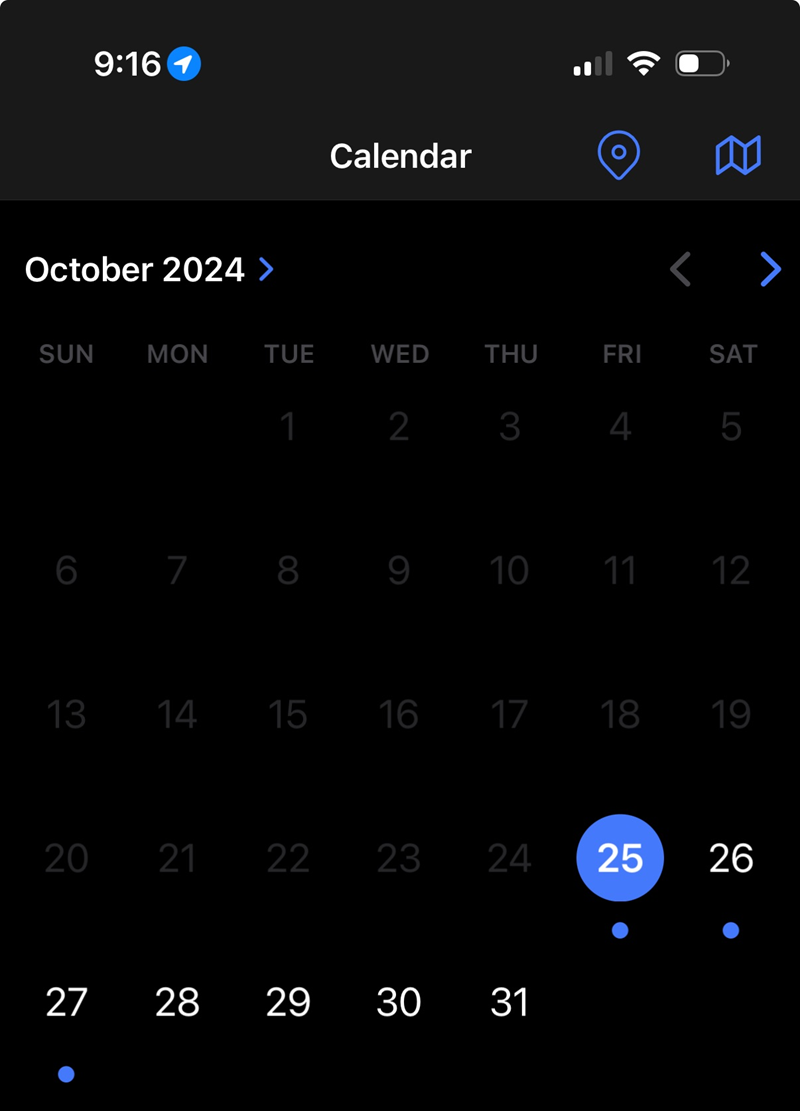
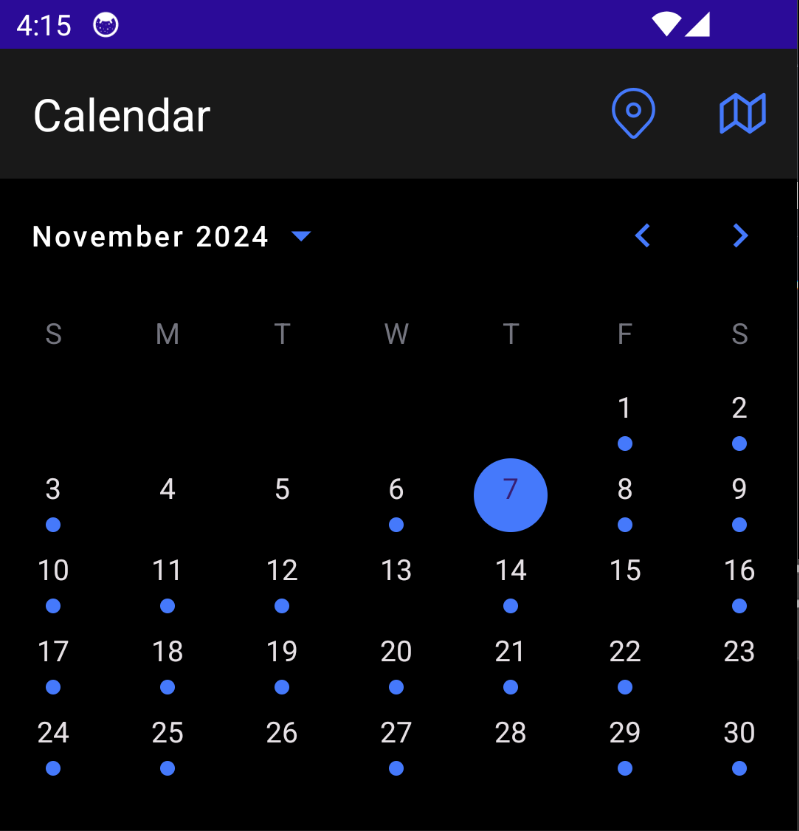
Android


Available on NuGet.
Install with the dotnet CLI: dotnet add package Plugin.Maui.NativeCalendar, or through the NuGet Package Manager in Visual Studio.
| Platform | Minimum Version Supported |
|---|---|
| iOS | 16+ |
| Android | 5.0 (API 21) |
Plugin.Maui.NativeCalendar provides the NativeCalendar class that displays a native calendar view in your .NET MAUI app.
The calendar view on iOS is implemented using UICalendarView.
The calendar view on Android is implemented using MaterialCalendar, a class used in the MaterialDatePicker from the Android Material library.
- iOS reports an intrinsic size, so the calendar sizes itself. A
HeightRequestis optional and only needed to override the natural height. - Android fills the height it is given but does not report an intrinsic height. The underlying
MaterialCalendaris a fragment whose size is not known until it renders. Give the control aHeightRequest, or place it in a slot with a definite height, for example aGridrow with height*orVerticalOptions="Fill"inside a bounded container.
| Feature | iOS (UICalendarView) |
Android (MaterialCalendar) |
|---|---|---|
| Single date selection | Yes | Yes |
Event indicator dots (Events, EventIndicatorColor) |
Yes | Yes |
TintColor for today and selected day |
Yes | Yes |
MinimumDate / MaximumDate |
Yes | Yes |
Self-sizing without a HeightRequest |
Yes | No, give it a height or a fill slot |
| Minimum OS | iOS 16 | API 21 |
The Events collection updates the calendar when the property is reassigned and when an ObservableCollection bound to it is changed in place.
No permissions are needed for iOS.
No permissions are needed for Android.
In order to enable the plugin, you need to call the UseNativeCalendar method in the MauiProgram.cs file of your .NET MAUI app.
  var builder = MauiApp.CreateBuilder();
        builder
            .UseMauiApp<App>()
            .UseNativeCalendar()   // <--- Add this line
            .ConfigureFonts(fonts =>
            {
                fonts.AddFont("OpenSans-Regular.ttf", "OpenSansRegular");
                fonts.AddFont("OpenSans-Semibold.ttf", "OpenSansSemibold");
});You'll need to add a xmlns namespace to your XAML page:
<ContentPage xmlns="http://schemas.microsoft.com/dotnet/2021/maui"
             xmlns:x="http://schemas.microsoft.com/winfx/2009/xaml"
             x:Class="Plugin.Maui.NativeCalendar.Sample.MainPage"
             xmlns:nativecalendar="clr-namespace:Plugin.Maui.NativeCalendar;assembly=Plugin.Maui.NativeCalendar"
             Title="Native Calendar Plugin">
And then consume your calendar in the XAML page:
 <!-- HeightRequest is necessary on Android. On iOS the calendar sizes itself, so it is optional. -->
 <nativecalendar:NativeCalendarView MaximumDate="{Binding MaximumDate}"
                                           MinimumDate="{Binding MinimumDate}"
                                           SelectedDate="{Binding SelectedDate}"
                                           Events="{Binding Events}"
                                           EventIndicatorColor="{Binding EventIndicatorColor}"
                                           HeightRequest="500"
DateChanged="NativeCalendarView_DateChanged" />Occurs when Date is selected via user interaction.
Command that is executed when Date is selected via user interaction.
Bindable property indicating the color of the current day and selected day on the calendar for iOS
Color of the Event Indicator, a dot that appears below the date number indicating there is an event on that date. Currently only allows single date selection.
Lowest date that can be selected on the calendar.
Greatest date that can be selected on the calendar.
Date that is currently selected on the calendar.
List of dates that have events. The calendar will display a dot below the date number to indicate there is an event on that date.