feat(muon): add Muon optimizer support to the DTensor backend - #2505
feat(muon): add Muon optimizer support to the DTensor backend#2505bzantium wants to merge 8 commits into
Conversation


Lay down the Muon adapter module that the DTensor backend will dispatch
into. This commit is single-GPU only and bit-exact against the vanilla
emerging_optimizers.Muon class so the math foundation is locked before
the TP-aware (Newton-Schulz over partition_dim) and dispatch wiring
commits land on top.

* nemo_rl/algorithms/muon/dtensor_muon.py: DTensorMuon extends
  emerging_optimizers.OrthogonalizedOptimizer. The orthogonalize step
  routes through the same primitives that emerging_optimizers.Muon uses
  (newton_schulz, get_muon_scale_factor) so per-step updates are
  bit-identical for the same input gradients and state. The TP-aware
  override is stubbed as a single-GPU pass-through; a follow-up commit
  switches it to newton_schulz_tp once the placement translator lands.
* nemo_rl/algorithms/muon/chained.py: ChainedTorchOptimizer wraps two
  torch.optim.Optimizer instances behind one step / state_dict /
  param_groups surface so the policy worker can keep treating
  self.optimizer as a single object.
* nemo_rl/algorithms/muon/builder.py: build_dtensor_muon walks
  model.named_parameters(), routes 2D non-embedding/non-norm/non-lm_head
  weights to DTensorMuon and the rest to torch.optim.AdamW, matching
  the linear vs nonlinear split in Megatron's get_megatron_muon_optimizer
  at 3rdparty/Megatron-LM-workspace/Megatron-LM/megatron/core/optimizer/muon.py:239-258.
* tests/unit/algorithms/test_dtensor_muon.py: 22 cases covering
  bit-exact equivalence vs vanilla Muon (3 scale modes x 3 coefficient
  types), multi-step + nesterov + weight_decay_method matrix,
  extra_scale_factor linearity, state_dict resume, ChainedTorchOptimizer
  semantics, and the param-split heuristics.

emerging_optimizers is imported lazily with a clear install-extras
error so the import does not break environments that do not have the
mcore / muon extras installed.

Signed-off-by: Minho Ryu <ryumin93@gmail.com>
Replace the hard-coded `optimizer_cls(model.parameters(), **kwargs)`
construction in dtensor_policy_worker.py and automodel/setup.py with a
single helper, build_optimizer_from_cfg, that dispatches based on a
marker attribute on the resolved callable.

* nemo_rl/utils/optimizer_factory.py: new helper that resolves the
  configured optimizer name to either a class or a builder function.
  Builders advertise model-aware construction by setting
  `_builds_optimizer_from_model = True` and receive the whole module
  rather than `model.parameters()`.
* nemo_rl/algorithms/muon/builder.py: tag build_dtensor_muon with the
  marker so the dispatch hands it the model and the linear vs nonlinear
  parameter split can run.
* nemo_rl/models/policy/workers/dtensor_policy_worker.py and
  nemo_rl/models/automodel/setup.py: call build_optimizer_from_cfg
  instead of the inline cls(model.parameters(), ...) pattern. Existing
  AdamW recipes hit the default branch and are unchanged.
* tests/unit/algorithms/test_dtensor_muon.py: two new tests cover the
  default AdamW dispatch and the muon builder dispatch end-to-end.

The resolver uses importlib directly rather than hydra.utils.get_class
because get_class rejects callables that are not classes, which would
prevent dispatching to the build_dtensor_muon factory function.

Signed-off-by: Minho Ryu <ryumin93@gmail.com>
…n_dim)

Override DTensorMuon.orthogonalize so a DTensor parameter is routed
through emerging_optimizers.muon_utils.newton_schulz_tp on its TP-mesh
process group. Plain tensors and DTensors with all-Replicate placements
keep the single-GPU pass-through that the previous commit established.

Mechanics
* Parse param.placements: take the first Shard placement as the TP axis
  and use placement.dim as partition_dim. Multi-axis sharding falls back
  to the single Shard path; multi-axis Muon TP is out of scope.
* Resolve the TP process group via param.device_mesh.get_group(axis) and
  hand it to newton_schulz_tp together with the local shard.
* Translate muon_tp_mode through to newton_schulz_tp's tp_mode argument:
  - blockwise and duplicated both call tp_mode="duplicated", which
    all-gathers and runs Newton-Schulz on the full matrix (matches
    Megatron's TensorParallelMuon at muon.py:87)
  - distributed forwards as-is, running Newton-Schulz on the local shard
    with cross-rank communication
* The scale factor is derived from the **global** matrix shape so the
  per-shard call still divides by the same denominator the single-rank
  computation uses.
* The orthogonalized local shard is wrapped back into a DTensor with the
  original placements so the base class's `p.add_(orth_grad, alpha=-lr)`
  stays type-consistent.

Tests (CPU + gloo backend via torch.multiprocessing.spawn)
* test_dtensor_muon_tp2_duplicated_matches_single_rank: TP=2 with
  duplicated and blockwise modes is bit-exact (rtol=0, atol=0) against
  the single-rank reference for both Shard(0) and Shard(1) layouts.
* test_dtensor_muon_tp2_distributed_matches_single_rank: distributed
  mode matches the reference within 5e-4 (Newton-Schulz's per-step
  all-reduces add expected FP slack).

Signed-off-by: Minho Ryu <ryumin93@gmail.com>
Add the per-head split-orthogonalize-concat path that Megatron's
TensorParallelMuon.orthogonalize uses for fused linear_qkv.weight
parameters, and detect those parameters automatically in
build_dtensor_muon. HF-style separated q_proj / k_proj / v_proj weights
are normal 2D matrices and stay on the regular Muon path with no
special handling.

* nemo_rl/algorithms/muon/dtensor_muon.py: add split_qkv, is_qkv_fn and
  qkv_split_shapes constructor knobs. orthogonalize() now branches into
  _qkv_split_orthogonalize when the param is reported as fused QKV; the
  split mirrors Megatron's logic at
  3rdparty/Megatron-LM-workspace/Megatron-LM/megatron/core/optimizer/muon.py:136-159
  including the (num_query_groups, q+k+v, hidden) reshape and the
  per-slice orthogonalize. The DTensor branch unwraps to the local
  shard, runs the split there, and re-wraps with the original
  placements so the base class step stays type-consistent.
* nemo_rl/algorithms/muon/builder.py: detect fused params via the
  ``*.linear_qkv.weight`` name pattern. Derive qkv_split_shapes from
  model.config (num_attention_heads / num_key_value_heads /
  head_dim, with HF and Megatron field names both supported), or accept
  an explicit override.

Tests
* test_build_dtensor_muon_separated_qkv_skips_split_path: HF-style
  q_proj/k_proj/v_proj go through Muon individually with split disabled.
* test_build_dtensor_muon_fused_qkv_with_explicit_shapes: a synthetic
  ``self_attention.linear_qkv.weight`` enables the split path and the
  is_qkv_fn correctly identifies the fused param.
* test_dtensor_muon_qkv_split_matches_per_slice_orthogonalize: the
  fused split-orth-concat is bit-exact against splitting the gradient
  manually and orthogonalizing each slice with scaled_orthogonalize_fn.

Signed-off-by: Minho Ryu <ryumin93@gmail.com>
Wrap up the Muon-on-DTensor work with a user-visible delta: a runnable
recipe, a nightly entry, the muon extras packaging, and the doc update.

* docs/guides/muon-optimizer.md: replace the "Megatron only" Requirements
  section with separate Megatron and DTensor checklists. The DTensor
  checklist references the new uv `muon` extras, the
  `nemo_rl.algorithms.muon.build_dtensor_muon` builder, the supported
  knob set (subset of the Megatron knobs since use_distributed_optimizer
  and overlap_param_gather are Megatron-DDP specific), and the new
  recipe.
* pyproject.toml: add a `muon` extras group that exposes
  `emerging-optimizers==0.2.0` to DTensor users without requiring the
  full mcore install. The mcore extras keep their existing pin so
  existing recipes are untouched.
* examples/configs/recipes/llm/sft-llama3.2-1b-1n8g-fsdp2tp1-muon.v1.yaml:
  runnable DTensor SFT recipe that mirrors the existing
  sft-llama3.2-1b-1n8g-fsdp2tp1.v3 recipe with the optimizer block
  swapped over to the Muon builder.
* tests/test_suites/llm/sft-llama3.2-1b-1n8g-fsdp2tp1-muon.v1.sh: nightly
  driver that runs the recipe and asserts a loosened loss budget vs the
  AdamW baseline (tighten in a follow-up after a full convergence sweep).
* tests/test_suites/nightly.txt: append the new driver under the SFT
  section.

Signed-off-by: Minho Ryu <ryumin93@gmail.com>


 github-actions
Bot
added
Documentation
github-actions
Bot
added
Documentation
Earlier commits validate the optimizer with end-to-end bit-exact tests vs
vanilla emerging_optimizers.Muon and multi-rank torchrun comparisons. The
DTensorMuon-specific branches (placement parsing for the FSDP+TP
composition case, the QKV split / orth / concat reshape) were only
verified indirectly through those end-to-end paths. Add isolated tests
so regressions surface in the smallest possible failure unit.

Placement parsing (single-process gloo + single_rank_pg fixture):
* test_placement_parser_replicate_only_dtensor_matches_plain_tensor:
  a Replicate-placement DTensor routes through the no-shard branch and
  produces the same per-step update as a plain-tensor input.
* test_placement_parser_picks_shard_axis_on_2d_mesh: a 2D ("dp", "tp")
  mesh with placements=[Replicate(), Shard(d)] (the FSDP+TP composition
  shape) selects the TP axis correctly for both d=0 and d=1.

QKV reshape invariants (pure-tensor, no distributed):
* test_qkv_split_preserves_total_rows_and_hidden_dim: round-trip with an
  identity orthogonalize must reconstruct the input shape exactly.
* test_qkv_split_preserves_slice_order_q_then_k_then_v: slices come back
  in Q -> K -> V order, parameterized across num_query_groups ∈ {1, 2, 5}
  (covers single-query-group and GQA cases).
* test_qkv_split_rejects_misaligned_grad_rows: row counts not divisible
  by sum(qkv_split_shapes) raise ValueError instead of silently bending
  per-head boundaries.
* test_qkv_split_mha_equal_q_k_v_shapes: per-head q == k == v (the MHA
  case) goes through the split path without losing structure.

Also force-set MASTER_PORT in the existing multi-rank workers so the
new single_rank_pg fixture's parent env does not leak through and pin
the spawned children to a port already bound by the fixture.

Signed-off-by: Minho Ryu <ryumin93@gmail.com>
Post-validation cleanup discovered while running a Megatron-vs-DTensor
Muon equivalence sweep on Llama-3.2-1B-Instruct (train-loss delta < 1e-3
over 100 steps):

- Bundle ``emerging-optimizers`` into the ``automodel`` extras and drop
  the standalone ``muon`` extras group. DTensor users now get the
  Newton-Schulz primitives from the same install set that ships the rest
  of the DTensor backend, and we avoid asking them to combine two extras
  (``automodel`` is mutually exclusive with ``mcore``, so a separate
  ``muon`` group could not be combined with both backends cleanly).

- Rename the DTensor builder kwarg ``muon_use_nesterov`` to
  ``muon_nesterov`` to match Megatron's ``OptimizerConfig`` field name.
  Mismatched naming made it easy to copy a Megatron recipe and silently
  drop nesterov; aligning the two backends removes the foot-gun.

- Filter ``None``-valued kwargs in ``build_optimizer_from_cfg``. Recipes
  that inherit from a base optimizer config (e.g. ``sft.yaml``'s AdamW
  with ``betas``/``eps``/``foreach``/``fused``) and switch to an optimizer
  whose signature does not accept those keys need a way to neutralize
  them; OmegaConf deep-merge keeps the keys with ``null`` values, and
  the factory now drops nulls before ``**kwargs`` unpacking. Adds a unit
  test that builds the DTensor Muon optimizer through the factory with
  the four AdamW-only fields explicitly nulled.

- Sync the docs guide (``automodel`` instead of ``muon`` extras, renamed
  knob) and the nightly recipe yaml.

Signed-off-by: Minho Ryu <ryumin93@gmail.com>

Megatron
|
Megatron dist_muon |
DTensor build_dtensor_muon |
|
|---|---|---|
| Model | meta-llama/Llama-3.2-1B-Instruct | meta-llama/Llama-3.2-1B-Instruct |
| Dataset | OpenMathInstruct-2 (split_validation_size 0.05) | (same) |
| Steps / GBS / MBS / seq | 100 / 32 / 2 / 2048 | (same) |
| Optimizer knobs | lr 2e-5, wd 0.1, momentum 0.9, scale=spectral, extra_scale_factor=0.2, split_qkv | (identical), tp_mode=duplicated |
| Train loss @ step 100 | 0.4355 | 0.4350 |
| Validation loss @ step 50 | 0.4961 | 0.4957 |
| max |Δ| over 100 steps | 0.0014 | |
| mean |Δ| over 100 steps | 0.0004 |
Δ stays within FP non-determinism for bf16 matmul and Newton-Schulz orthogonalization across the two backends, which confirms the DTensor builder reproduces the Megatron dist_muon math.
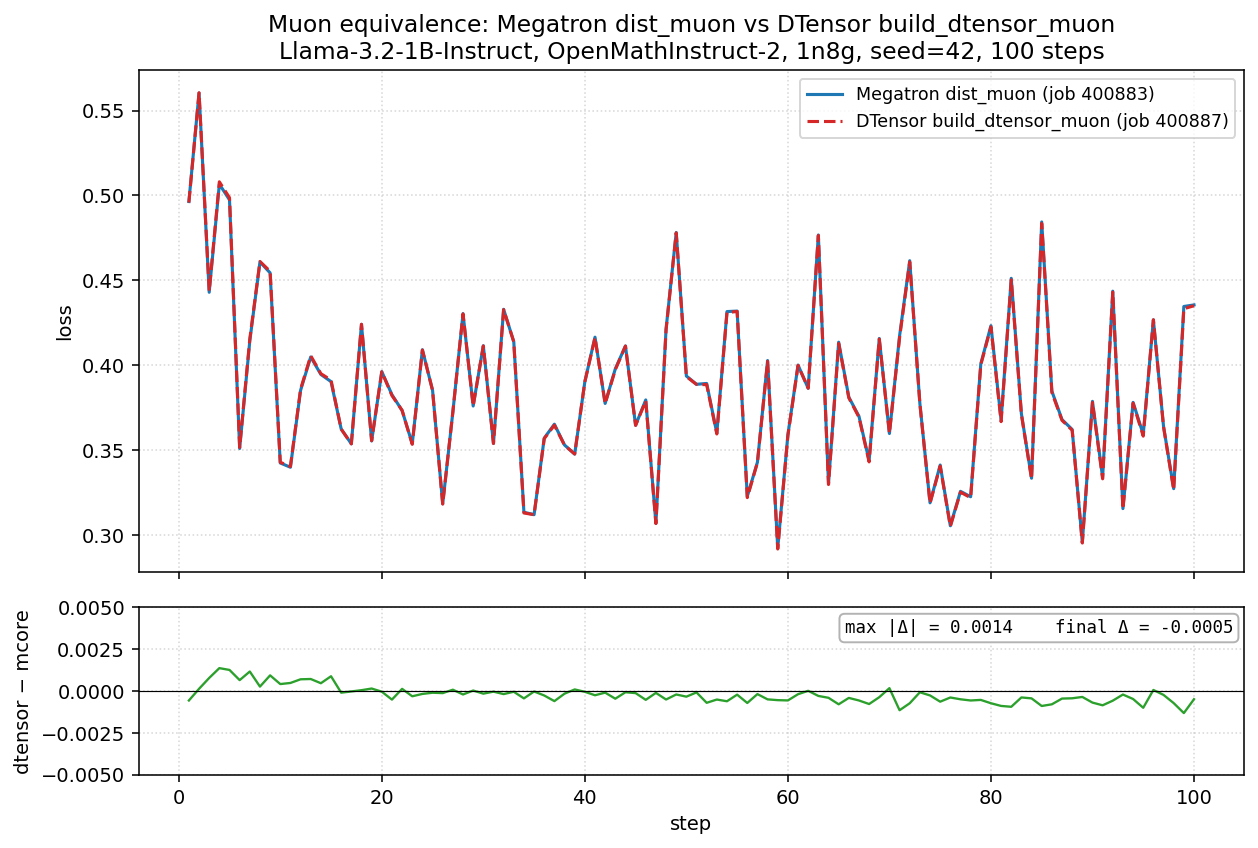
Top panel: train loss for both backends (mcore solid blue, dtensor dashed red). Bottom panel: per-step delta (dtensor − mcore).
Throughput is not a controlled comparison here (mcore ~144 TFLOPS, dtensor ~75 TFLOPS at this shape). The DTensor backend's per-step cost is dominated by HuggingFace model-fwd rather than Muon orthogonalization, so closing the gap is orthogonal to the equivalence check this PR is about and belongs in a separate follow-up.
Code-review polish:
- Collapse the multi-line docstring on
  test_optimizer_factory_drops_none_valued_kwargs to a single line; the
  long form duplicated optimizer_factory.py's own WHY comment.
- Mirror the sibling test by asserting the inner optimizer type
  (DTensorMuon) in addition to ChainedTorchOptimizer, so the test
  documents the dispatch result, not just "didn't TypeError".

Signed-off-by: Minho Ryu <ryumin93@gmail.com>
 svcnvidia-nemo-ci
added
the
waiting-on-maintainers
svcnvidia-nemo-ci
added
the
waiting-on-maintainers
2 participants


What does this PR do ?
Brings the Muon optimizer (MomentUm Orthogonalized by Newton-Schulz, https://arxiv.org/abs/2502.16982) to the DTensor backend.
docs/guides/muon-optimizer.md:11previously documented the optimizer as Megatron-only; this PR lifts that restriction so users on FSDP2 / TP recipes can train with Muon without switching backends.The optimizer math is reused verbatim from NVIDIA's
emerging_optimizerspackage (the same one Megatron'sdist_muonshims over). The DTensor side is a thin adapter: a placement topartition_dimtranslator, an all-gather path fortp_mode="duplicated", andnewton_schulz_tpfor the distributed path. Equivalence is verified to bit-exact (atol=0, rtol=0) vs upstreamemerging_optimizers.Muonon single-GPU, bit-exact for TP=2duplicated/blockwise, within 5e-4 for TP=2distributed, and max |Δ| 1.4e-3 across a 100-step Llama-3.2-1B SFT smoke vs Megatrondist_muonon identical recipe. The Megatrondist_muonpath and existing AdamW recipes are untouched; the dispatch is name-based innemo_rl/utils/optimizer_factory.py.Issues
Closes #2510.
Usage
uv sync --extra automodelbrings inemerging-optimizersfor DTensor users; the existingmcoreextras still ship the same package for the Megatron path.Before your PR is "Ready for review"
Pre checks:
Additional Information
PytorchOptimizerConfigalready accepts an openkwargsdict); no hidden defaults in code, and the exemplar recipe carries the explicit knob set.importlibdirectly rather thanhydra.utils.get_classbecauseget_classrejects callables that are not classes, which would prevent dispatching to thebuild_dtensor_muonfactory function.