- Comparison: EF Core vs Entity Framework Extensions
- Provider: MySQL
- EF Version: EF Core 9.x
- Benchmarks executed with BenchmarkDotNet (25 iterations, 1 warmup).
- Results may vary depending on hardware, configuration, and dataset size.
- Connection string defined in
appsettings.json.
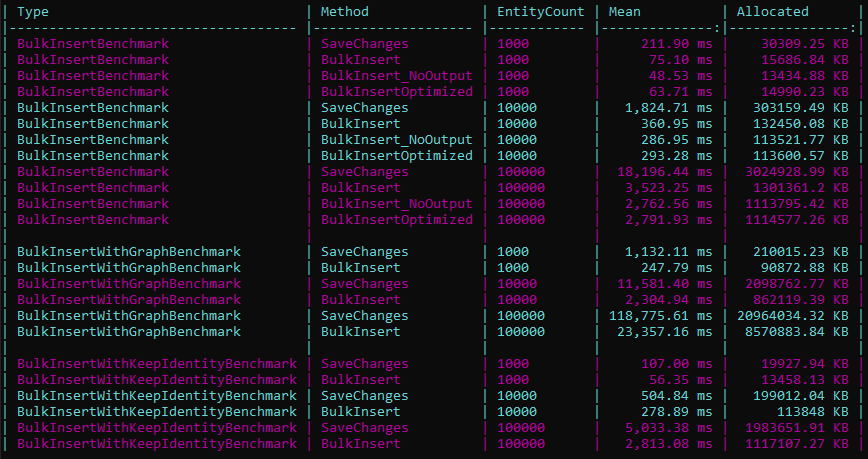
Description:
This chart shows Bulk Insert benchmarks on MySQL, including plain insert, insert with graph, and insert with keep identity.
In all scenarios, Entity Framework Extensions is significantly faster than EF Core and often uses less memory.
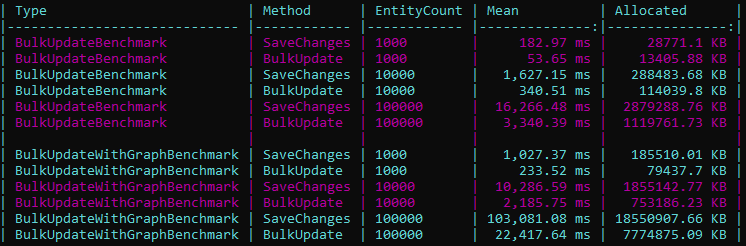
Description:
This chart shows Bulk Update benchmarks on MySQL, including plain update and update with graph.
In all scenarios, Entity Framework Extensions is significantly faster than EF Core, with memory usage improvements in most cases.
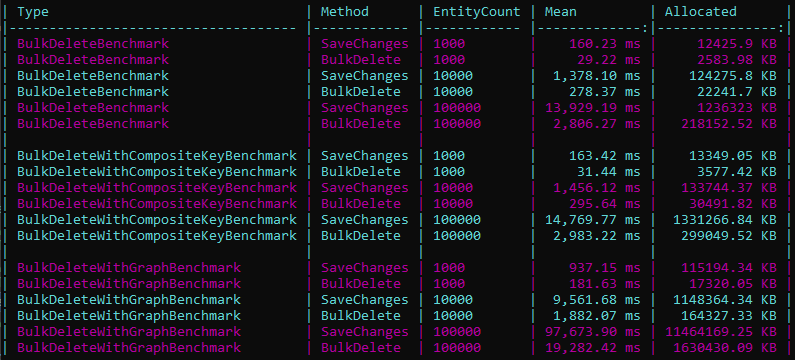
Description:
This chart shows Bulk Delete benchmarks on MySQL, including plain delete, delete with composite keys, and delete with graph.
In all scenarios, Entity Framework Extensions is significantly faster than EF Core and usually more memory-efficient.
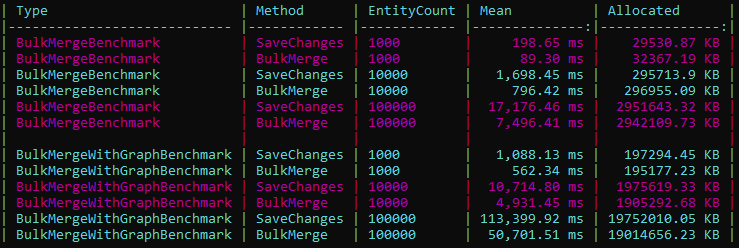
Description:
This chart shows Bulk Merge benchmarks on MySQL, including plain merge and merge with graph.
In all scenarios, Entity Framework Extensions is significantly faster than EF Core and typically consumes less memory.

Description:
This chart shows Bulk Synchronize benchmarks on MySQL.
Only Entity Framework Extensions is included, since EF Core has no equivalent method to compare.
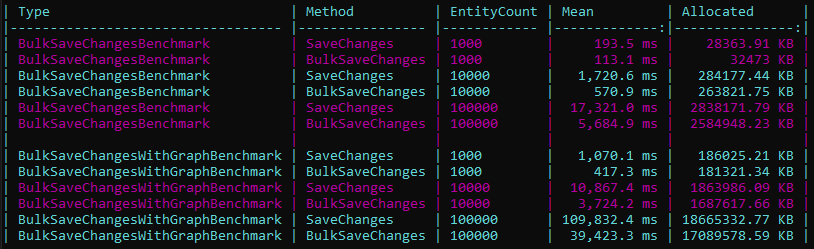
Description:
This chart shows Bulk SaveChanges benchmarks on MySQL, including plain SaveChanges and SaveChanges with graph.
In all scenarios, Entity Framework Extensions is significantly faster than EF Core and often uses much less memory.
Across all tested operations on MySQL, Entity Framework Extensions provides substantial benefits compared to EF Core:
- Performance: EF Extensions consistently delivers faster execution, often reducing processing time by more than 90%.
- Memory Usage: In most scenarios, EF Extensions uses considerably less memory than EF Core, though some variations show usage close to EF Core levels.
- Features: With advanced operations like Bulk Synchronize, EF Extensions introduces capabilities not available in EF Core.
For teams building applications on MySQL, EF Extensions offers both speed and scalability improvements, making it a powerful solution for high-volume data operations.